5K to 10K training plan in 8 weeks
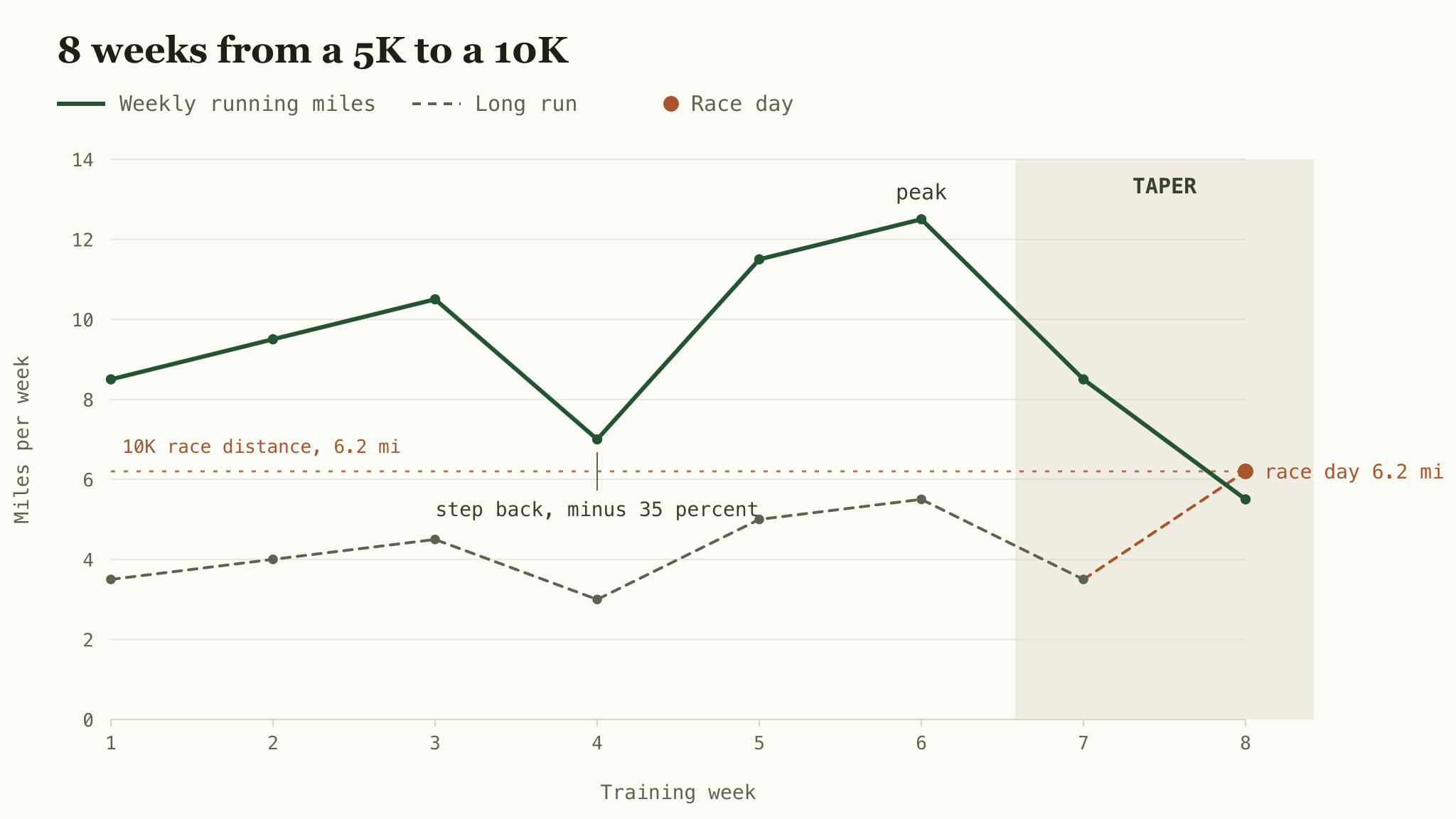
Eight weeks, if you can already run 5K without stopping. That is what Hal Higdon's Novice 10K program takes: three runs and two cross-training days a week, with a long run that climbs from 3 miles to 5.5 and never reaches the race distance. Doubling the distance is a smaller job than it sounds, because almost nothing about the training changes. You add one longer run, a little weekly mileage, and patience. Here is the week-by-week ladder, how fast to add the miles, and what your 5K time already says about your 10K time.
How long does it take to go from 5K to 10K?
Eight weeks for most people. Four is enough if you already run 5K three times a week and finish it comfortably. Hal Higdon's Novice 10K runs 8 weeks with three runs a week. Marathon Handbook's beginner 5K to 10K plan runs 4 weeks and asks for that comfortable, unbroken 5K first. The gap between those two numbers is your current base.
Be honest about what "can run a 5K" means. The NHS Couch to 5K plan ends with a 30-minute continuous run, which is not the same thing as 5 kilometers. At a true beginner pace, 30 minutes covers closer to 2.5 miles. Running the full 5K inside half an hour is already a mid-pack parkrun time: the average UK parkrun finish in August 2025 was 29:30, counting every finisher including the walkers. If you graduated from our couch to 5k plan last week, spend three or four weeks running the full 5K comfortably before you start counting down to a 10K.
Then work backwards from a real date. The 10K is a well-stocked distance: RunRepeat counted 1.8 million 10K finishers worldwide in 2018, against 2.9 million at 5K. Find one eight weeks out, pay the entry, and count back from race day. If you want to know exactly what you are signing up for in miles and track laps, how far a 5K is covers the shorter one, and a 10K is that twice over, 6.21 miles or 25 laps.
What changes between 5K and 10K training
Not much, and that is the useful part. Same easy runs, same single harder session, same rest days, same shoes. Two things change. The long run gets longer, and the race settles onto an effort you have to hold for an hour instead of half of one.
That hour matters more than it sounds. Jack Daniels defines threshold pace as the fastest pace you can race for about 60 minutes, and for anyone finishing a 10K between 50 and 70 minutes, 10K race pace and threshold pace are the same number. A 5K forgives a slightly hot start because it is over before the damage compounds. A 10K does not.
The long run does the rest of the work. In our 8-week beginner build it starts at 3.5 miles and tops out at 5.5, which is exactly where Higdon's Novice 10K also stops. Neither plan asks you to cover 6.2 miles in training.
The eight week ladder
Here is the shape our generator produces for a beginner, four days a week, eight weeks out from race day, in miles:
- Week 1, 8.5 miles total, 3.5 mile long run
- Week 2, 9.5 miles, 4 mile long run
- Week 3, 10.5 miles, 4.5 mile long run
- Week 4, 7 miles, 3 mile long run (step back)
- Week 5, 11.5 miles, 5 mile long run
- Week 6, 12.5 miles, 5.5 mile long run (peak)
- Week 7, 8.5 miles, 3.5 mile long run (taper)
- Week 8, 5.5 easy miles plus the 10K on race day
Week 4 is the one people argue with. Nobody earns it, and that is the point: it is a scheduled cut of about 35 percent, and it is there because adaptation happens while the load is off. Skip it and week 5 feels heavier than the numbers say it should. The peak lands in week 6, two weeks out, which leaves the last two weeks to shed fatigue without shedding fitness.
The same plan in kilometers reads 14, 15, 17, 11, 19, 20, 13 and 9 a week, with the long run climbing 6, 6.5, 7.5, 4.5, 8, 9 and then coming down. Pick whichever unit you already think in. The plan is identical either way.
How much should weekly mileage go up?
At or under 10 percent a week, and never more than 30 percent across a two-week stretch. Nielsen and colleagues followed 874 novice runners with GPS watches for a year and found that the ones who pushed past 30 percent over two weeks picked up more distance-related injuries than the ones who stayed under 10: runner's knee, iliotibial band syndrome and shin splints.
Treat 10 percent as a ceiling rather than a target. A randomized trial of 532 novice runners found no injury difference between a graded 10 percent build and a standard one, which our couch to half marathon guide goes through in more detail. Our generator caps every week-over-week rise at 10 percent and drops one week in the middle, and that shape matters more than hitting a number every Sunday.
Put the extra miles in the long run first and in one easy run second. The most common way to wreck an eight-week block is to add a fifth running day, which stacks new impact on legs that have not finished absorbing the last lot. Cycling, swimming and rowing add aerobic work without the pounding. Higdon's Novice 10K schedules two cross-training days a week for exactly that reason.
Do you have to run 10K before race day?
No, and most beginner plans deliberately stop short. Higdon's Novice 10K peaks at a 5.5 mile long run in week 7, so the first 10K you ever run is the race itself. Our generator lands on the same 5.5 miles for an 8-week beginner build. The last 0.7 miles come from the taper, race-day adrenaline, and everyone around you still moving.
Give the plan twelve weeks instead of eight and the long run does clear the race distance, topping out at 6.5 miles in week 9 before the three-week taper. That is a confidence builder, not a requirement. Running the full distance in training costs more recovery than it returns, and the recovery comes out of the easy runs that were building your fitness in the first place.
Doubling the race distance does not double the time. Pete Riegel fitted a power law to world records from 100 meters to 100 miles and found a fatigue exponent of 1.06, which makes the multiplier for twice the distance 2.085, not 2. Your 10K will cost about 4 percent more per mile than your 5K did. Pace the first mile off your 5K time and the correction comes due around mile four.
Source: Riegel P.S., Athletic Records and Human Endurance, American Scientist, 69(3):285-290, 1981.What will your first 10K time be?
Multiply your 5K time by 2.09. Pete Riegel's endurance formula takes your known time and multiplies it by the ratio of the two distances raised to the power 1.06. For a doubling, that multiplier works out to 2.085. So a 30:00 5K predicts 1:02:33, and a 35:00 5K predicts 1:12:58.
- 22:00 5K predicts about 45:52
- 25:00 predicts about 52:07
- 28:00 predicts about 58:23
- 30:00 predicts about 1:02:33
- 32:00 predicts about 1:06:43
- 35:00 predicts about 1:12:58
- 40:00 predicts about 1:23:24
In pace terms that is roughly 4 percent slower per mile. A 10:00 mile at 5K effort becomes a 10:25 mile at 10K effort, and a 6:00 kilometer becomes 6:15. Two caveats. Riegel fitted his exponent to world records, so a first-timer off an eight-week build usually finishes a minute or two on the slow side of the prediction. And the formula assumes you trained for both distances, which is the whole point of the eight weeks.
How many days a week should you run?
Three if you came straight off Couch to 5K, four once you have been running 5Ks for a couple of months. Add the fourth day before you add miles to the three you have, because frequency builds a 10K more safely than length does.
One long run on the weekend, one harder session midweek, and the rest easy enough to talk in full sentences. Our generator puts intervals on Wednesday for 5K and 10K plans and swaps in a tempo run for half marathon and marathon plans, because at 6.2 miles the sharper session still pays for itself. Every week keeps at least one full rest day. If you are hitting four runs and feel flat by Thursday, the easy runs are too fast. Easy days run hard are how a four-day week quietly turns back into a three-day one.
The taper is short, and it still counts
Two weeks, and about half the volume. In the ladder above, week 7 cuts 32 percent off the peak week and race week cuts 56 percent, while the pace of every session stays exactly where it was. That tracks what the research recommends: a meta-analysis of taper studies found the best results from a two-week taper that reduces volume by 41 to 60 percent and leaves intensity and frequency alone, worth roughly 3 percent on race day.
Three percent of a 62-minute 10K is close to two minutes, which is more than most people gain from the last hard week they were tempted to squeeze in. Our guide to how a taper works covers why running less makes you faster, and what to do with the restless legs in race week.
Put the plan on paper
You do not have to build this by hand. Our free running plan generator takes your race date, your distance and your current level, and returns the whole eight weeks as a printable PDF with the step-back week, the intervals and the taper already placed. Pick the 10K distance and the beginner level if you are coming off a first 5K. No signup, no email, no app.
Print it and stick it somewhere you walk past. Eight weeks is short enough that ticking off sessions on paper carries you through the two or three days a month when going out is the last thing you want to do.
Sources
- Hal Higdon, Novice 10K training program: 8 weeks, three runs and two cross-training days a week, long run from 3 to 5.5 miles, week 8 is the race (halhigdon.com).
- Riegel P.S., Athletic Records and Human Endurance, American Scientist, 69(3):285-290, 1981; fatigue exponent 1.06 fitted to records from 100 m to 100 miles (pubmed.ncbi.nlm.nih.gov).
- Nielsen R.O. et al., Excessive Progression in Weekly Running Distance and Risk of Running-Related Injuries, Journal of Orthopaedic and Sports Physical Therapy, 2014; 874 novice runners tracked by GPS for one year (jospt.org).
- Buist I. et al., No Effect of a Graded Training Program on the Number of Running-Related Injuries in Novice Runners: A Randomized Controlled Trial, American Journal of Sports Medicine, 2008; 532 runners (pubmed.ncbi.nlm.nih.gov).
- Bosquet L. et al., Effects of Tapering on Performance: A Meta-Analysis, Medicine and Science in Sports and Exercise, 2007 (pubmed.ncbi.nlm.nih.gov).
- Jack Daniels, Daniels Running Formula: threshold pace is the fastest pace raceable for about 60 minutes, close to 10K pace for less trained runners.
- NHS, Get running with Couch to 5K: nine weeks, three runs a week, finishing on a 30-minute continuous run (nhs.uk).
- The Running Channel, average parkrun finish times by country, August 2025: UK 29:30, global average around 32 minutes (therunningchannel.com).
- RunRepeat, The State of Running 2019: 107.9 million race results from more than 70,000 events, 1986 to 2018; 1.8 million 10K participants and 2.9 million 5K participants in 2018 (runrepeat.com).
- Marathon Handbook, 5K to 10K training plan: four weeks, four running days, prerequisite is a comfortable unbroken 5K, weekly volume 17 to 25 km (marathonhandbook.com).
- TrailTaper running plan generator, src/calc/running.ts: 8-week beginner 10K build, peak 12.5 miles a week and a 5.5 mile long run, 35 percent deload in week 4, two-week taper (trailtaper.com).
Frequently asked questions
How long does it take to go from 5K to 10K?
Eight weeks is the standard answer, and it matches Hal Higdon's Novice 10K program. Four weeks is enough if you already run 5K three times a week without walk breaks. If you finished Couch to 5K in the last month, give yourself the full eight and spend the first two running 5K comfortably.
Do I need to run 10K in training before the race?
No. Higdon beginner 10K peaks at a 5.5 mile long run in week 7 and our own 8-week beginner build stops at the same distance. The remaining 0.7 miles come from the taper and race day itself. On a twelve-week build the long run does pass 6.2 miles, which is nice but not necessary.
How many miles a week do I need for a 10K?
A beginner block peaks near 12 to 13 miles a week over four runs, or about 20 kilometers, with the long run making up close to half the total. More mileage buys you a faster time, not a finish. Keep the weekly increase under 10 percent and never add more than 30 percent across two weeks.
What is a good first 10K time?
Take your 5K time and multiply it by 2.09. A 30-minute 5K predicts about 1:02:30 and a 35-minute 5K predicts about 1:13:00. Riegel formula was fitted to world-record holders, so most first-timers land a minute or two slower than the prediction. That is normal, not a training failure.
How much slower is 10K pace than 5K pace?
About 4 percent per mile. A 10:00 mile at 5K effort becomes roughly a 10:25 mile at 10K effort, and a 6:00 kilometer becomes about 6:15. That difference sounds small and it is the reason people blow up at mile four. Start the 10K feeling like you are holding back.
Can I go straight from Couch to 5K to a 10K plan?
You can, with one change. Couch to 5K finishes on a 30-minute continuous run, not necessarily on 5 kilometers, so spend two to four weeks running the full 5K at an easy pace before week 1 of the 10K block. Adding that base is the cheapest injury insurance in the plan.