Marathon taper: how much to cut, and when to start
A marathon taper cuts your weekly mileage by 41 to 60 percent over the last two or three weeks while your training paces stay where they were. In 158,117 recreational marathons tracked on Strava, the runners who held a strict three-week taper finished a median 5 minutes 32 seconds faster than the runners who barely tapered. Here is how much to cut each week, what to keep, how the numbers change for a half, a 10K, a 5K or a big hike, and the habits that undo the whole thing.
What a taper actually is
A taper is a planned drop in training volume in the final stretch before your goal event. Mujika and Padilla, who wrote the standard review of the subject in 2003, define it as a progressive, non-linear reduction of the training load, and their prescription is narrow: hold the intensity, cut the volume, and reduce how often you train by no more than 20 percent.
That last part is where the word volume earns its keep. You are cutting the amount of running, not the quality of it, and you are not cutting the number of days you lace up. Three of those four dials stay where they are.
How much mileage should you cut?
Cut 41 to 60 percent of your peak weekly volume across the taper, and leave your paces alone. That band is not a coach's hunch. It is the answer two separate meta-analyses arrived at, sixteen years apart, from different pools of studies, and it has held up every time somebody has gone looking for a better number.
Mujika and Padilla put the usual payoff at about 3 percent, with a spread of 0.5 to 6 percent across the studies they reviewed. On a four-hour marathon, 3 percent is seven minutes. You do not get many seven-minute gifts in this sport, and this one costs you nothing but nerve.
Two meta-analyses landed on the same number. Bosquet and colleagues pooled 27 taper studies in 2007 and found the best results came from cutting training volume 41 to 60 percent over about two weeks with intensity and frequency untouched. A 2023 review of 14 studies and 174 endurance athletes tested the same bands and again found 41 to 60 percent the strongest, with a standardized mean difference of 0.77 on time-trial performance.
Sources: Bosquet et al., Effects of Tapering on Performance, Medicine and Science in Sports and Exercise, 2007; Wang et al., PLOS One, 2023.Keep the pace, shorten the run
The instinct during a taper is to make the runs easier. Do the opposite of that instinct with the pace and follow it with the distance. If you had a tempo run of 6 miles at half-marathon effort, run the same effort for 4 miles. If you had 6 x 800m, run 4 x 800m at the same speed. The 2023 review found no benefit at all to dropping intensity during a taper, and the conventional taper it beat most clearly was the one where people quietly stopped running hard.
Cut the easy miles instead. Your 8 mile Tuesday becomes 5. Your 20 mile Sunday becomes 12, then 8. The hard sessions shrink by roughly 20 to 30 percent and keep their bite.
How long should a marathon taper be?
Three weeks, if you are running a marathon off a full training block. Two weeks is the classic lab answer and it works, but the biggest real-world dataset we have points to three, and it points there most strongly for the recreational runners this site is built for.
Barry Smyth and Aonghus Lawlor at University College Dublin pulled Strava training logs for 158,117 marathon finishes between 2014 and 2017 and sorted the tapers by length and by discipline. A strict taper meant the down weeks ran consecutively into race day. A relaxed taper meant a down week, then an up week, then more panic. Strict three-week tapers came with a median saving of 5 minutes 32 seconds, or 2.6 percent, over a token taper. Strict two-week tapers saved about 3 minutes 41 seconds. A fourth week was no better than two.
Two details from that paper are worth sitting with. About 90 percent of those runners tapered for two or three weeks, so the length is not where most people go wrong. But 69 percent of them tapered loosely, sneaking an up week into the run-in, and that is where the minutes leaked out. Women gained more than men from the same taper: 3.12 percent against 2.14 percent on a strict two-week taper.
Shorter events need less. The 2023 meta-analysis found the largest effect in the 8 to 14 day band, which fits: a 5K block leaves you carrying far less fatigue than an 18 week marathon build, so there is less to shed.
The three-week taper, week by week
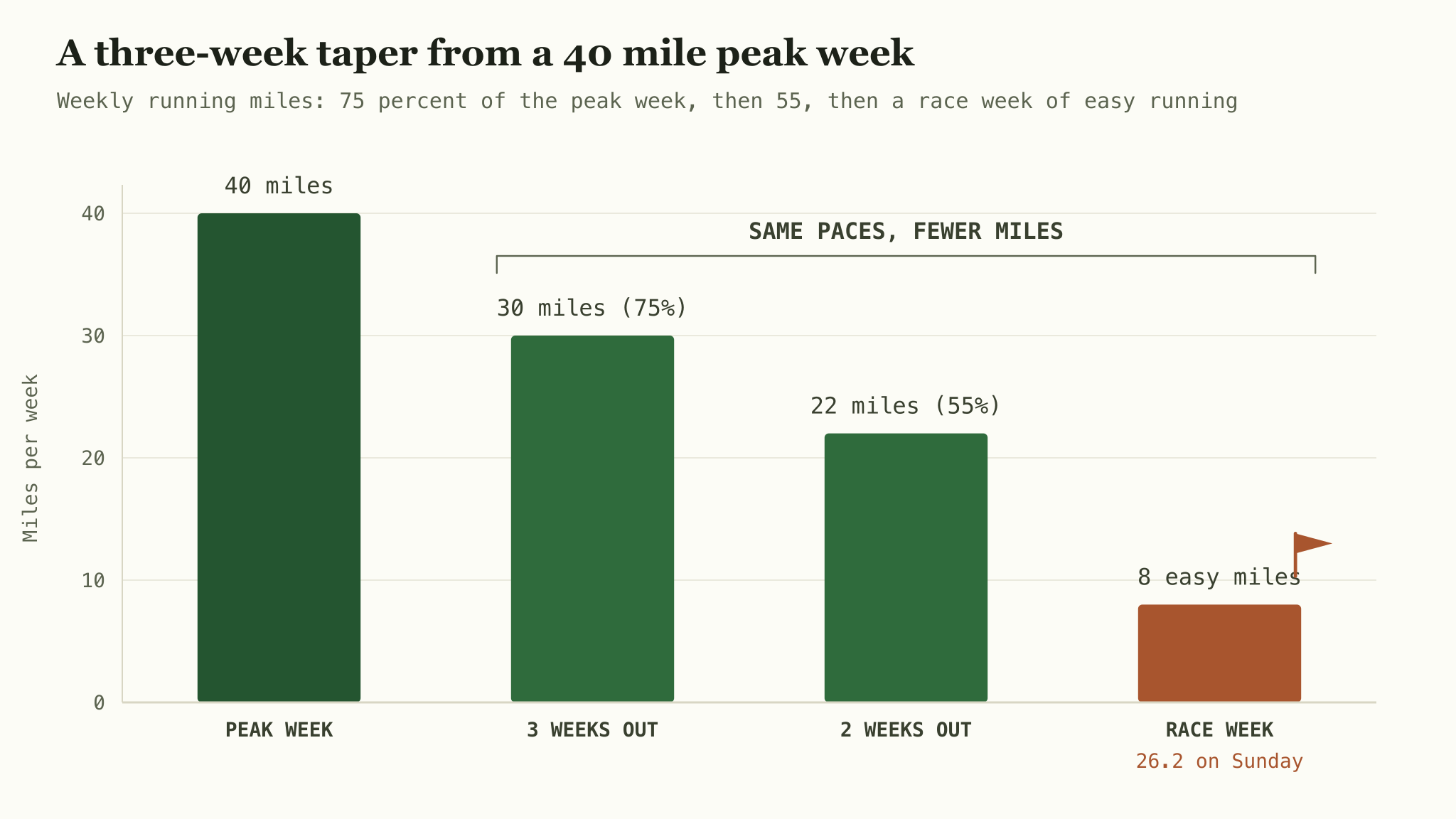
Here is what those percentages look like on a runner whose peak week was 40 miles. It is the mileage shape our own generator lays out, at 75, 55 and 40 percent of the peak week, and it lines up closely with the three-week taper in Advanced Marathoning by Pete Pfitzinger and Scott Douglas, which cuts about 20 to 25 percent, then 40, then 60.
Three weeks out, run about 30 miles. This is where your last long run goes, 16 miles at easy pace, and it is the last time you will be tired. Keep the midweek workout, shortened.
Two weeks out, run about 22 miles. The long run drops to 10 or 12. Do your last real workout here, something like 3 miles at goal marathon pace inside an 8 mile run. After this session you are done training; everything left is maintenance.
Race week, run 7 to 10 easy miles before the start. An easy 4 on Wednesday. Three miles on Friday with four 20 second strides so your legs remember what fast feels like. Rest Saturday. Then 26.2 on Sunday. If the low mileage makes you twitchy, that is the taper working, not failing.
Half marathon, 10K and 5K tapers
A half marathon wants about two weeks. Drop to roughly 65 percent of your peak week for the first, then 45 percent for race week, and keep one shortened quality session in each. Our couch to half marathon plan ends on that shape: week 19 drops to about 13 miles from a 22 mile peak, a 41 percent cut, and race week is three short easy runs with two days off.
For a 5K or 10K, 7 to 10 days is enough. Coach Laura Norris puts the volume cut at 30 to 50 percent for these distances and keeps the intervals, shortened, with the last hard session 3 to 4 days before the gun. On 25 miles a week, that means about 15 miles in race week: a Tuesday session of 5 x 400m at 5K pace, two easy 3 milers, a shakeout, and the race.
The pattern is the same at every distance. The taper scales with the size of the hole you dug, not with the length of the race itself.
Do you taper before a big hike or backpacking trip?
Yes, and one to two weeks is usually the right size. A loaded hiking build stacks the same kind of fatigue a running block does, plus the joint and shoulder wear that comes with carrying weight, and you want none of it left on day one of the trip.
Mountain Tactical Institute gives clean dates to work back from in its backpacking guidance. Your last back-to-back weekend of loaded carries sits no closer than two weeks out. Your final single day pack hike lands about seven days out. Your last strength session goes no closer than five days out. After that you walk, you stretch, you sleep.
Keep the pack on during the taper hikes even as the distance falls. Shoulders and hips adapt to load, and two weeks of unloaded walking gives that adaptation away for nothing. Our hiking training plan generator does exactly this: on a long block it holds your real pack weight through the taper weeks and cuts distance and elevation to about 70, 50 and 35 percent of the peak week instead. For the full shape of a hiking block, see what a good hiking training plan looks like.
Will you lose fitness by running less?
No, and the detraining research is where the confusion starts. A 2024 review in Frontiers in Physiology collects what happens when athletes stop completely: VO2max fell about 7 percent after 12 days of rest in Coyle's runners and cyclists, and 4.7 percent after 14 days in Houmard's distance runners, whose resting plasma volume also dropped about 5 percent.
Those are numbers for stopping. A taper is not stopping. You keep the same number of runs, the same paces, and roughly half the miles, which is nothing like two weeks on the sofa. The 2023 meta-analysis measured VO2max and running economy through real tapers and found no meaningful change in either, while time-trial performance improved anyway. Read that twice, because it is the whole argument: the taper does not add fitness, and it does not cost you any. It removes fatigue so you can finally use what you already built.
Race week, in order
Your last hard session is 3 to 4 days out, and it should feel comfortably fast rather than heroic. Anything harder than that is a race you are not being scored on.
Start eating for the race about 36 to 48 hours before the start. The marathon nutrition review by Louise Burke puts the loading target at 10 to 12 grams of carbohydrate per kilogram of body weight per day across that window, which for a 70 kg runner is 700 to 840 grams a day. That is a lot more bread than people expect, and it is the reason your legs feel heavy and your weight ticks up on race morning. Both are good signs.
Nothing new in race week. No new shoes, no new gels, no first-ever massage, no bold curry. Sleep is the one thing you can still add to your race, and the night that matters most is two nights before, since almost nobody sleeps well the night before a start.
Expect the phantom aches. A knee that twinges, a calf that feels tight, a general sense of having forgotten how to run. They show up in taper week for most runners and they leave on race morning. Do not investigate them with an extra tempo run.
Five ways runners ruin a taper
- Squeezing in a missed long run. The fitness from it arrives about three weeks later, which is after your race, and the fatigue arrives immediately.
- Racing the final workout. A 6 mile tempo that turns into a time trial buys you a slower Sunday.
- Cutting days instead of miles. Going from six runs to three is the frequency cut Mujika and Padilla warn against. Run six times, run shorter.
- Filling the free time with something else. A long hike, a house move, or three gym sessions all count as training load, whatever your watch calls them.
- Tapering loosely. That up week in the middle is the difference the Dublin study measured across 158,000 runners, and it cost them minutes.
Let the plan build the taper for you
You do not have to do this arithmetic yourself. The running plan generator takes your race date, distance and current mileage and lays out the whole block with the taper already stepped down, week by week, as a printable PDF. Plans of 12 weeks or more get a three-week taper, 7 to 11 weeks get two, and anything shorter gets one. The hiking plan generator does the same for a trip, with the pack weight held and the miles cut. Both are free, with no signup and no paywall.
If you want the training that comes before the taper, our walkthrough of a marathon training plan covers the build, the long runs and the deloads that make a taper worth taking.
Sources
- Bosquet L., Montpetit J., Arvisais D., Mujika I., Effects of Tapering on Performance: a meta-analysis, Medicine and Science in Sports and Exercise, 2007 (pubmed.ncbi.nlm.nih.gov).
- Wang Z., Wang Y., Gao W., Zhong Y., Effects of tapering on performance in endurance athletes: a systematic review and meta-analysis, PLOS One, 2023 (journals.plos.org).
- Smyth B. and Lawlor A., Longer Disciplined Tapers Improve Marathon Performance for Recreational Runners, Frontiers in Sports and Active Living, 2021 (frontiersin.org).
- Mujika I. and Padilla S., Scientific Bases for Precompetition Tapering Strategies, Medicine and Science in Sports and Exercise, 2003 (journals.lww.com).
- Barbieri A. et al., Cardiorespiratory and metabolic consequences of detraining in endurance athletes, Frontiers in Physiology, 2024 (frontiersin.org).
- Burke L. et al., Nutrition strategies for the marathon: fuel for training and racing, Sports Medicine, 2007 (pubmed.ncbi.nlm.nih.gov).
- Pfitzinger P. and Douglas S., Advanced Marathoning, Human Kinetics, for the three-week taper structure (via published summaries of the plans).
- Mountain Tactical Institute, backpacker preseason training plan and pre-trip taper timing (mtntactical.com).
- Norris L., running coach, 5K or 10K taper: what to know to do it right (lauranorrisrunning.com).
Frequently asked questions
How much should I cut in a marathon taper?
Cut your weekly volume by 41 to 60 percent across the taper while keeping your paces and your number of runs. That range comes from two meta-analyses, Bosquet in 2007 and Wang in 2023, which tested several bands and landed on the same one. On a 40 mile peak week that means about 30 miles, then 22, then a race week of easy running.
How long should a marathon taper be?
Three weeks for a marathon off a full block. Analysis of 158,117 recreational marathons found a strict three-week taper worth a median 5 minutes 32 seconds against a token one, with two weeks worth about 3 minutes 41. Four weeks added nothing. Shorter races need less, and a 5K or 10K is well served by 7 to 10 days.
Should I stop running completely the week before a race?
No. Complete rest leaves most runners flat, and the research finds no benefit to dropping intensity during a taper. Keep the same number of runs at the same paces and cut the distance. A short session with a few strides 3 to 4 days out keeps your legs sharp without adding fatigue you cannot clear in time.
Will I lose fitness during a taper?
No. The fitness losses people quote come from studies where athletes stopped training entirely: about 7 percent off VO2max after 12 days of rest. A taper keeps your frequency and your paces and cuts about half the miles. In tapering studies VO2max and running economy did not move, and performance improved anyway.
How long should a half marathon or 5K taper be?
About two weeks for a half marathon, dropping to roughly 65 percent of your peak week and then 45 percent, and 7 to 10 days for a 5K or 10K with a 30 to 50 percent volume cut. The rule is that the taper matches the fatigue you built, so a long marathon block needs the longest run-in.
Do you taper before a big hike or backpacking trip?
Yes, one to two weeks. Put your last back-to-back weekend of loaded carries at least two weeks out, your final pack hike about a week out, and your last strength session no closer than five days. Keep wearing the real pack on the shorter hikes so your shoulders stay used to the load.