What a good hiking training plan looks like
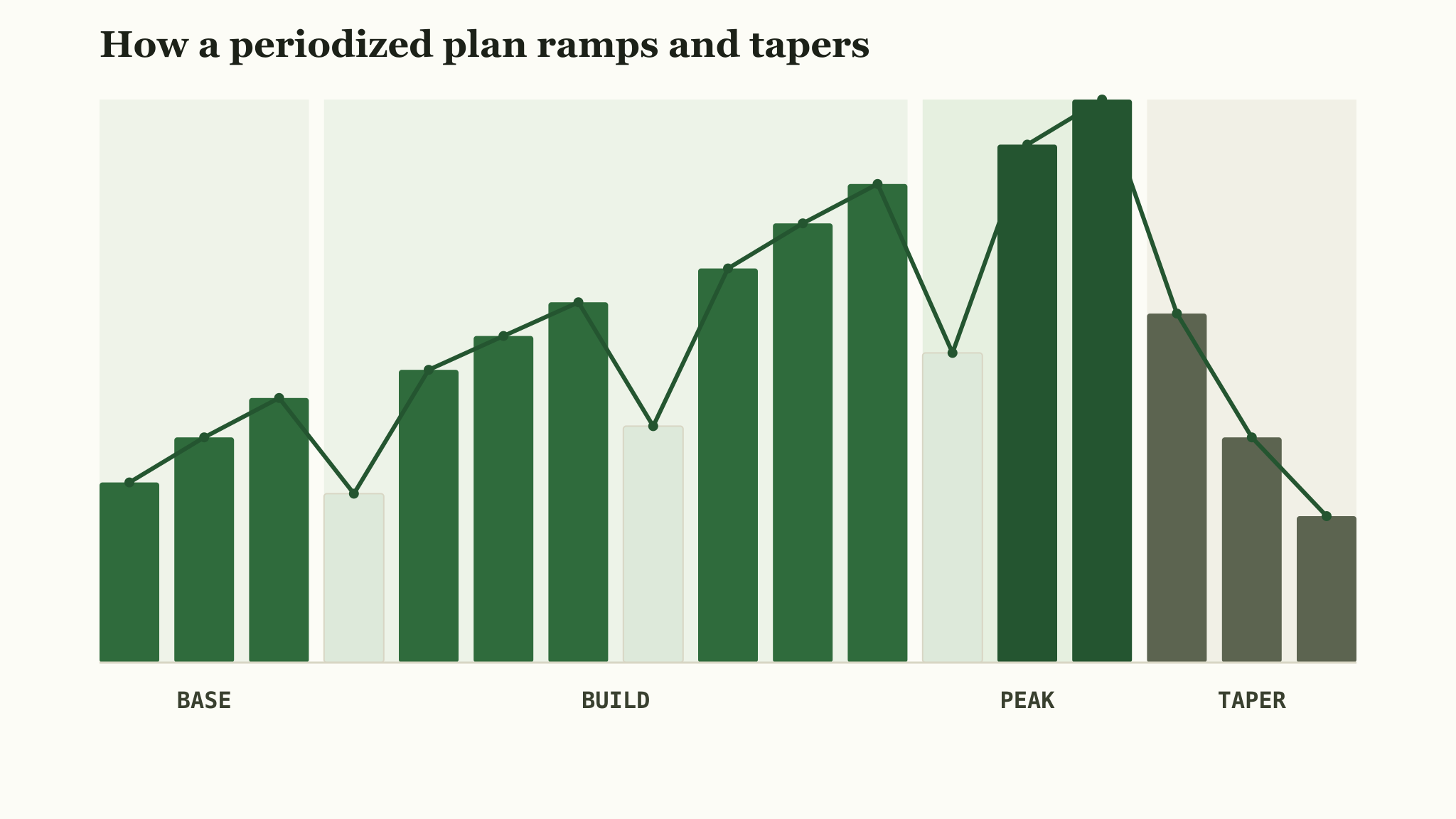
A pile of long hikes is not a training plan. A plan has a shape. It starts easy, gets harder in a controlled way, includes weeks where you deliberately back off, peaks at the right time, and then steps down so you arrive rested. That structure has a name, periodization, and it is what separates a plan that builds fitness from a stack of random hard days that wears you out. Here is what each phase is for.
Periodization in plain terms
Periodization just means organizing training into phases, each with a different job, instead of doing the same thing every week. The idea is old and well established in endurance coaching: you apply a stress, you let the body recover and adapt, then you apply a slightly larger stress. Done in the right order, those cycles add up to real fitness. Done at random, they add up to fatigue and a nagging knee.
For a hiker preparing for one big trip, the phases usually run base, build, peak, then taper, with recovery weeks folded in. You do not need a coach or a spreadsheet to follow the shape; you just need to know what each phase is trying to do so you do not skip the parts that feel optional.
Base: build the engine
The base phase builds general endurance. The sessions are mostly easy to moderate, the goal is consistency rather than intensity, and you are teaching your body to walk for a long time without falling apart. This is where you build the habit and the connective-tissue resilience that lets you handle the harder work later. Rush this phase and the build phase has nothing to stand on.
Build: ramp distance, elevation, and pack
In the build phase the plan starts loading the specific demands of your trip: longer hikes, more climbing, and a heavier pack. The trick is to grow these one at a time rather than all at once. Stretch the long hike for a few weeks, then start adding elevation, then bring in pack weight as the trip nears. Changing a single variable at a time keeps the jump in total stress sane and makes it obvious what caused any soreness.
A widely cited guideline in endurance training is the ten percent rule, the idea that weekly training load should rise by no more than about ten percent at a time. It is best treated as a sensible brake rather than a precise law: a 2007 systematic review found limited evidence that the exact figure prevents injury, so let your own body, not the number, set the ceiling.
Source: Buist et al., systematic review on training-volume progression and running injury, 2007 to 2008.Why a deload week makes you stronger
Training does not make you fitter on its own. It breaks the body down, and the rebuilding happens during rest. That is why a good plan schedules a deload, a week where you drop volume by roughly a third every third or fourth week, on purpose. The deload lets accumulated fatigue clear so the previous weeks finally convert into fitness. It feels like a step backward and is actually the moment the work pays off. Skipping it is the single most common way hikers ramp straight into an overuse injury.
Peak: your hardest, most specific work
The peak phase holds your longest and most trip-like sessions: the biggest loaded climbs, the longest days, the back-to-back hikes if your route demands them. By now your body has the base and the build behind it, so it can absorb this work. The peak is short by design, because these sessions cost the most to recover from. Once you have proven you can handle a day close to your hardest trip day, the building is done.
Taper: arrive fresh, not flat
The taper is the final phase, usually one to two weeks for a hike. You cut total volume sharply while keeping a few shorter, sharper sessions so you stay loose. The point is to clear the fatigue from all that training while holding on to the fitness, so you reach the trailhead rested instead of run down. Tapering feels counterintuitive, since you are doing less right before the hardest thing you have trained for, but the research on reduced-volume tapers is clear that it works. We cover the why in our dedicated guide to what a taper is.
Let the plan do the math
Following this shape by hand means juggling distance, elevation, pack weight, deload timing, and the taper all at once. Our free hiking training plan generator does it for you: enter your goal date, distance, elevation gain, and pack weight, and it lays out a week-by-week printable plan with the base, build, peak, deloads, and taper already arranged. No signup, no paywall, just a plan you can print and follow.
If you want the hands-on detail behind the build and pack work, read our guide on how to train for a backpacking trip.
Sources
- REI Expert Advice, Training for a Hike, conditioning phases and progression (rei.com).
- Buist I. and colleagues, graded running program and injury risk, a randomized controlled trial questioning the ten percent rule (pubmed.ncbi.nlm.nih.gov).
- Bompa and Buzzichelli, Periodization: Theory and Methodology of Training, on phase structure and recovery cycles.
Frequently asked questions
What are the phases of a hiking training plan?
Most sound plans move through four phases: a base phase to build general endurance, a build phase where distance, elevation, and pack weight climb, a peak phase with your longest and hardest sessions, and a taper where you cut volume so you arrive fresh. Recovery weeks are woven through the build and peak so the work actually sticks.
What should I ramp up: distance, elevation, or pack weight?
All three, but not all at once. Changing one variable at a time, then holding the others steady, keeps the jump in total stress manageable and makes it clear what caused any soreness. A common pattern is to grow your long hike first, then layer in elevation, then add pack weight as your trip approaches.
Why do I need a deload or recovery week?
Training breaks the body down; rest is when it rebuilds stronger. A deload week, usually every third or fourth week, drops your volume by roughly a third so that accumulated fatigue clears and the previous weeks of work convert into real fitness. Skipping recovery is the most common way hikers ramp straight into an overuse injury.
How fast can I increase my weekly hiking load?
A familiar guideline is to add no more than about ten percent to your weekly load at a time. It is a useful brake rather than a precise law, and research has questioned how strictly it holds, so the real ceiling is how your body responds. New aches or lasting tiredness mean hold steady or back off.
How long should a hiking taper be?
For a big hike, a taper of about one to two weeks is usually enough. You reduce total volume while keeping a few shorter, sharper sessions so you stay loose without adding fatigue. The harder and longer your trip, the more a proper taper helps you show up rested rather than run down.