Couch to half marathon in 20 weeks
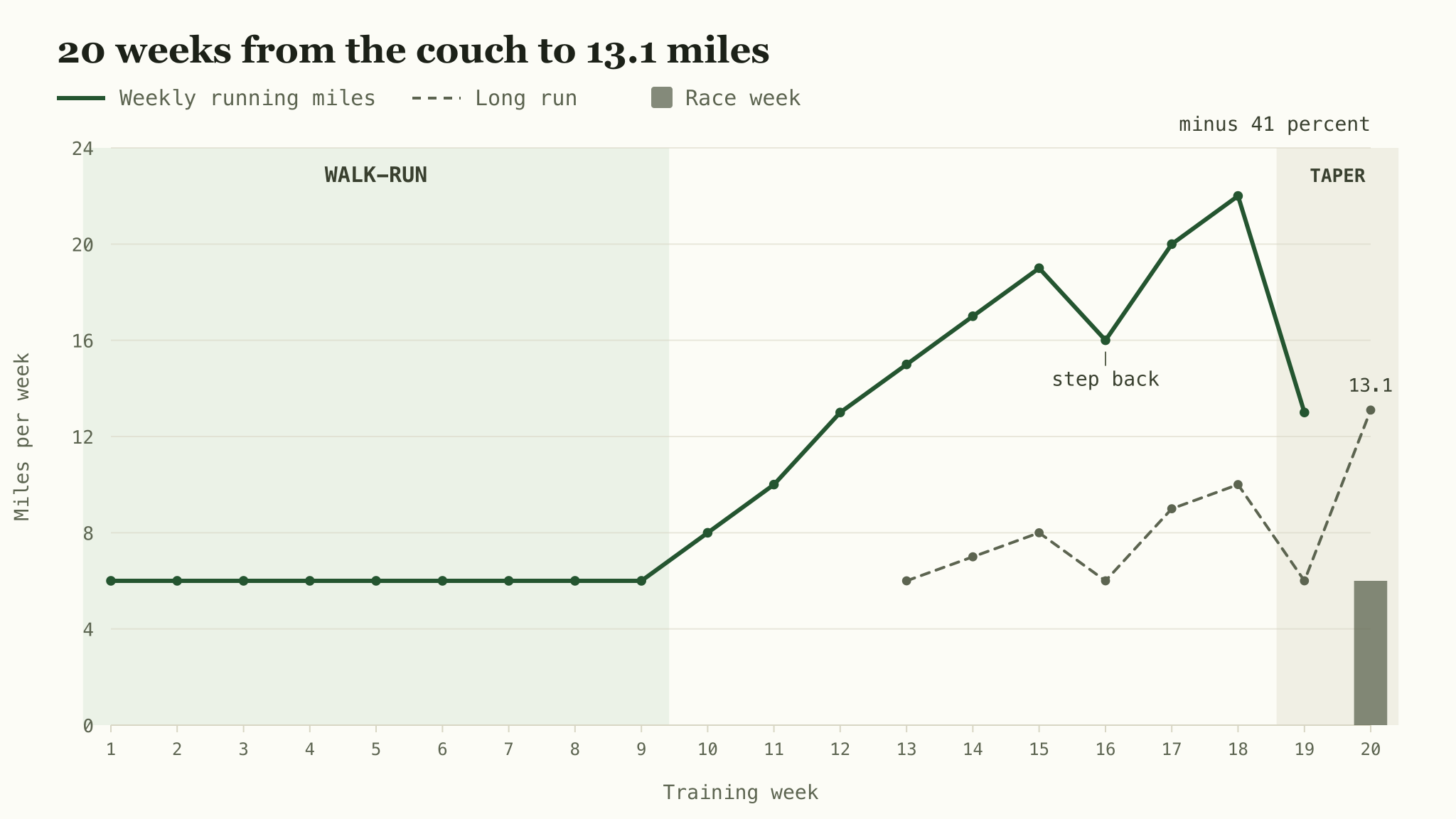
Twenty weeks, about five months, is the honest answer if you do not run at all right now. Published couch to half marathon plans land between 16 and 20 weeks, and the two-stage route most coaches point beginners toward runs a little longer than that: roughly nine weeks of walk-run training to reach 30 minutes of continuous running, then a twelve-week half marathon build on top of it. Hal Higdon's beginner half plan puts its prerequisite in the first line, that you can already run 3 miles three or four times a week. Skipping that line is how a lot of first attempts end early. Here is the week-by-week shape, how long your longest run should be, and where the injury risk sits.
How long does it take to go from the couch to a half marathon?
Plan on 20 weeks. A beginner needs about nine weeks to get from walking to 30 minutes of continuous running, then twelve more to stretch that into 13.1 miles. Sixteen weeks is enough if you can already jog for 10 minutes without stopping. Twelve weeks from zero is where first-timers get hurt.
The nine-week figure comes from the NHS Couch to 5K plan: three runs a week, starting at 60 seconds of running against 90 seconds of walking, finishing at a 30-minute run. The twelve-week figure comes from Hal Higdon's Novice 1 half marathon program, which runs four days a week and peaks at a 10-mile long run in week 11. Stack the two and you get 21 weeks. Round to 20 and it fits a calendar.
Work backwards from a real date. Pick a half marathon that is 20 weeks out, pay the entry, and count back from race day. An entry fee is a better commitment device than a vague plan to get fit, and it pins down the one variable everything else depends on. If the only race you want is 14 weeks away, either find a later one or go in expecting to walk some of it.
What the 20 weeks look like
Four blocks, and the dull one is the longest.
Weeks 1 to 9: walk to run
You are not training for a half marathon yet. You are teaching your connective tissue to tolerate impact, and that takes calendar time rather than effort. Three sessions a week, each about 30 minutes, each one a mix of running and walking that tilts toward running as the weeks pass. By week 9 you run 30 minutes without a walk break, which at a beginner pace covers somewhere near 2.5 miles. Our couch to 5k plan guide walks through that progression session by session, and how far a 5K is covers what those first distances work out to in miles and laps.
Weeks 10 to 12: the bridge
Three weeks to turn 30 minutes into distance. Keep three runs a week, add a fourth if the first nine weeks felt fine, and let one of them grow: 3.5 miles, then 4, then 5. Weekly total climbs from about 8 miles to 13. This block is what Higdon's plan assumes you already did, and it is the piece almost every twelve-week schedule leaves out.
Weeks 13 to 18: the build
Now the long run does the work. It goes up most weeks, steps back once, and tops out at 10 miles two weeks before the race:
- Week 13, 6 miles
- Week 14, 7 miles
- Week 15, 8 miles
- Week 16, 6 miles (step back)
- Week 17, 9 miles
- Week 18, 10 miles
- Week 19, 6 miles (taper)
- Week 20, race day, 13.1 miles
Around the long run sit two or three easy runs of 3 to 4 miles. Weekly mileage rises from roughly 15 to about 22. The step back at week 16 is not a rest week you have earned, it is a scheduled one: adaptation happens while the load is off, and a beginner carrying nine weeks of new impact needs the gap more than an experienced runner does.
Weeks 19 to 20: the taper
Cut the volume, keep the frequency and the pace. Week 19 drops to about 13 miles with a 6-mile long run, which is a 41 percent cut from the 22-mile peak. Race week is three short easy runs and two full days off. That is close to what the research recommends: a meta-analysis of taper studies found the best results from a two-week taper that reduces volume by 41 to 60 percent while leaving intensity and frequency alone, worth about 3 percent on race day. Our guide to how a taper works covers why doing less makes you faster.
Novice runners are hurt at 17.8 injuries per 1000 hours of running, against 7.7 per 1000 hours for recreational runners who already have a base. That gap is the best argument for spending the first nine weeks walking and running instead of jumping straight into a twelve-week half marathon schedule.
Source: Videbaek et al., Incidence of Running-Related Injuries Per 1000 h of Running in Different Types of Runners, Sports Medicine, 2015.Do you have to follow the 10 percent rule?
No, and the best trial on it came up empty. Buist and colleagues randomly assigned 532 novice runners to either a 13-week graded program built on the 10 percent rule or a standard 8-week program. Injuries landed at 20.8 percent and 20.3 percent. The difference was nothing (P = .90).
What the evidence does support is a ceiling rather than a target. Nielsen and colleagues followed 874 novice runners with GPS watches for a year and found that those who raised weekly distance by more than 30 percent over a two-week stretch picked up more distance-related injuries than those who stayed under 10 percent, specifically runner's knee, iliotibial band syndrome and shin splints. So the practical version is: do not chase 10 percent every week, and do not jump 30. Weekly mileage in the ladder above grows about 8 percent a week on average across the build, with one week down in the middle. The shape matters more than hitting a number every Sunday.
How long should your longest training run be?
Ten to eleven miles, not 13.1. Higdon's beginner half peaks at 10 miles in week 11 of 12. Marathon Handbook's 16-week couch to half plan peaks at 11 miles. Those last two miles come from the taper and race day itself, and running the full distance in training costs more recovery than it buys.
Time on your feet is the number that counts for a first half. At a 2:30 finish, which is a realistic target off a beginner plan, race pace is about 11:26 a mile. A 10-mile long run at that pace takes 1:54, or 76 percent of the time you will spend racing. Your legs have already done the hard part. If a long run pushes past about two and a half hours, it starts eating the rest of the week, and the easy runs that build fitness get skipped.
How many days a week should a beginner run?
Three, or four at most, with a rest or cross-training day after each one. The NHS plan uses three. Higdon's Novice 1 uses four runs a week alongside cross-training and rest days. Adding a fifth running day is the most common way a beginner turns a good block into a stress fracture.
The injury numbers explain the caution. In a 2015 meta-analysis, novice runners were hurt at 17.8 injuries per 1000 hours of running, against 7.7 per 1000 hours for recreational runners with a base behind them. New runners carry more than double the risk per hour, and the gap closes only as the base builds. That is what the first nine weeks buy you. Cycling, swimming and rowing all add aerobic work without the impact, so put them on the cross-training days if you want more.
How fast should the easy runs feel?
Slow enough to hold a conversation. If you cannot speak a full sentence, you are running your easy days too hard, and that is the single most common reason a long run stops growing. Most of the miles in a beginner plan sit at that conversational pace.
Beginners run easy days too fast because slow feels like cheating. It is the opposite: the easy miles are what let you run four times a week instead of two, and frequency is what builds a half marathon. Save the effort for the long run, and even there, run the first half slower than feels right. A 10-mile run finished strong teaches you more than an 8-mile run you had to walk home from.
What is a realistic first half marathon time?
Between 2:15 and 2:45 for most people finishing their first one off a beginner plan. For reference, Marathon Handbook's set of more than 124,000 half marathon finishes averages 1:50:15 overall, 1:43:33 for men and 2:00:12 for women, but that pool is full of people on their tenth race, not their first.
Walk breaks are allowed and they are not a failure. Plenty of first-timers run four minutes and walk one the whole way, and the clock barely notices: a 12:00 average mile, walk breaks included, brings you home in 2:37. What sinks a first half is going out at the pace of the crowd around you in mile one and paying for it at mile nine.
Put the plan on paper
You do not have to build this schedule by hand. Our free running plan generator takes your goal race, your date and your current fitness, and gives you the whole block as a printable PDF with the step-back weeks and the taper already placed. Pick the half marathon distance and a start point of walk-run if you are beginning from nothing. No signup, no email.
Print it, put it on the fridge, and tick the sessions off. A plan you can see beats a plan on a phone you have to open, and the ticking off is most of the point in weeks 4 through 9, when nothing feels like progress yet.
Sources
- Buist I. et al., No Effect of a Graded Training Program on the Number of Running-Related Injuries in Novice Runners: A Randomized Controlled Trial, American Journal of Sports Medicine, 2008; 532 runners, 20.8 against 20.3 percent (pubmed.ncbi.nlm.nih.gov).
- Videbaek S. et al., Incidence of Running-Related Injuries Per 1000 h of Running in Different Types of Runners: A Systematic Review and Meta-Analysis, Sports Medicine, 2015; 17.8 for novices against 7.7 for recreational runners (pubmed.ncbi.nlm.nih.gov).
- Nielsen R.O. et al., Excessive Progression in Weekly Running Distance and Risk of Running-Related Injuries, Journal of Orthopaedic and Sports Physical Therapy, 2014; 874 novice runners tracked by GPS for one year (jospt.org).
- Hal Higdon, Novice 1 half marathon program: 12 weeks, four runs a week, assumes a base of 3 miles three to four times a week, peaks at a 10-mile long run in week 11 (halhigdon.com).
- NHS, Get running with Couch to 5K: 9 weeks, three runs a week, starting at 60-second runs (nhs.uk).
- Bosquet L. et al., Effects of Tapering on Performance: A Meta-Analysis, Medicine and Science in Sports and Exercise, 2007 (pubmed.ncbi.nlm.nih.gov).
- Marathon Handbook, average half marathon times from an in-house set of over 124,000 finishes, and a 16-week couch to half marathon plan peaking at 11 miles (marathonhandbook.com).
Frequently asked questions
How long does it take to go from couch to half marathon?
About 20 weeks, or five months, from no running at all. Roughly nine weeks takes you from walking to a 30-minute continuous run, and twelve more build that into 13.1 miles. Sixteen weeks works if you can already jog 10 minutes. Twelve from zero is a stretch.
Can I train for a half marathon in 12 weeks with no running base?
You can finish one, and you raise your injury odds doing it. Standard twelve-week beginner plans, including Hal Higdon's Novice 1, assume you already run 3 miles three or four times a week before week one. Without that base, use the twelve weeks to reach it and race later.
What is the longest run before a half marathon?
Ten to eleven miles, two weeks out. Higdon's beginner half peaks at 10 miles in week 11 of 12, and most sixteen-week couch plans peak at 11. Running the full 13.1 in training costs more recovery than it returns, and the taper plus race day covers the difference.
How many miles a week do I need for a half marathon?
A beginner block peaks near 20 to 24 miles a week, spread over three or four runs. That is roughly 15 miles a week when the build starts and 22 at the top, with the long run making up about half the total. Higher weekly mileage helps your time, not your finish.
Is it OK to walk during a half marathon?
Yes, and planned walk breaks beat unplanned ones. Running four minutes and walking one from the start keeps your pace steadier than running until you fall apart at mile nine. A 12:00 average mile with walk breaks included still finishes in 2:37.
Do I need to follow the 10 percent rule?
Not as a rule. A randomized trial of 532 novice runners found the same injury rate, 20.8 against 20.3 percent, whether they followed a 10 percent graded build or a standard one. The evidence supports a ceiling instead: avoid raising weekly distance by more than 30 percent over two weeks.