How far is a 5K? 3.1 miles, 12.5 laps, 5,000 meters
A 5K is 5 kilometers, which works out to 3.1 miles, 5,000 meters, or 12.5 laps of a running track. Most new runners finish one in 30 to 40 minutes and most walkers cover it in 45 to 60. In 2.2 million US race results from 2024 the median finish was about 36 minutes. Here is what 5 kilometers looks like in miles, laps, steps, and minutes, plus what each pace gives you at the line.
How far is a 5K in miles?
A 5K is 3.106 miles, which almost everyone rounds to 3.1. The K stands for kilometer, so 5K means 5 kilometers, and one mile is 1.609344 kilometers. Divide 5 by 1.609344 and you land on 3.10686 miles. In other units it is 5,000 meters or 16,404 feet.
For any distance in kilometers, multiply by 0.62 to get miles in your head. Five times 0.62 is 3.1, which is close enough to run by. Going the other way, a mile and a bit over is 2 kilometers, and 3 miles falls about 200 meters short of a 5K. That last gap catches people out on treadmills: stopping at 3.00 miles leaves you 172 meters early.
How many laps around a track is a 5K?
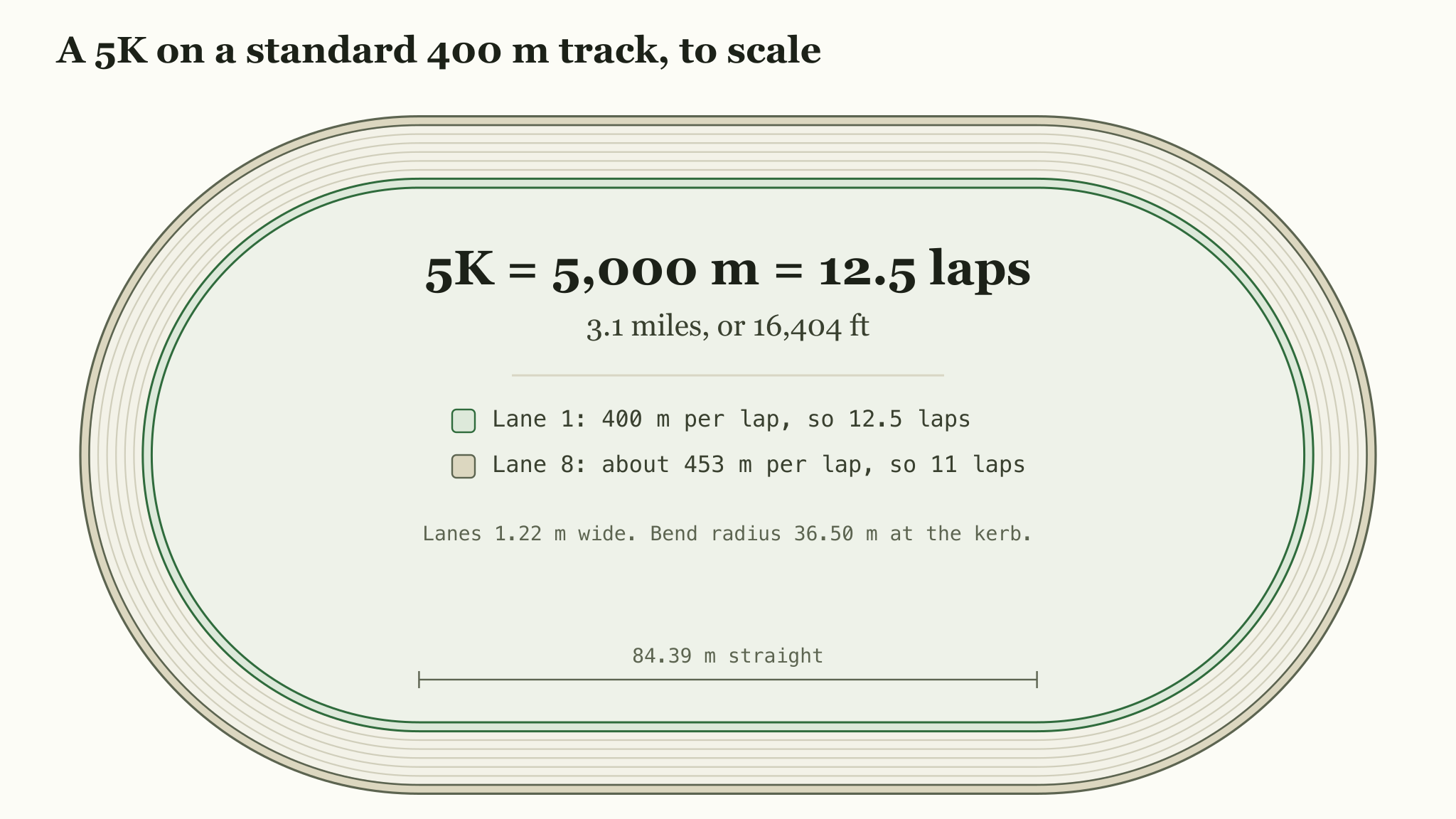
A 5K is 12.5 laps of lane one. World Athletics builds a standard outdoor track to 400 meters in lane one, measured along a line 30 cm out from the kerb, with two 84.39 meter straights and two curves. Divide 5,000 by 400 and you get 12.5 exactly.
Outer lanes are longer, because the curves grow while the straights stay put. Lanes are 1.22 meters wide, so lane eight comes out near 453 meters a lap and covers 5,000 meters in a little over 11 laps. On a 200 meter indoor track a 5K is 25 laps. The 5,000 meters is also an Olympic track event, so unlike a road course with its rolling hills and tight turns, the distance is exact.
How long does it take to run or walk a 5K?
Most new runners finish in 30 to 40 minutes and most walkers take 45 to 60. An analysis of 2.2 million US 5K results from 2024 put the median near 36 minutes, about 32 for men and 39 for women. Under 20 minutes is rare: only 1.85 percent of that field managed it.
Across 2.2 million US 5K results from 2024, the median finish was near 36 minutes, roughly 32 for men and 39 for women. Only 1.85 percent of those finishers broke 20 minutes, so a 30-minute 5K is a good day for a recreational runner, not a slow one.
Source: analysis of 2.2 million 2024 US 5K road-race results, reported by Outside Run.Your own time is arithmetic once you know your pace. Multiply your minutes per mile by 3.1, or your minutes per kilometer by 5. The kilometer version is the easy one. A 6:00 per kilometer pace is a 30:00 5K on the nose, and 7:00 per kilometer is 35:00.
In minutes per mile, here is what the clock says at the finish:
- 9:00 per mile, 27:58
- 10:00 per mile, 31:04
- 11:00 per mile, 34:11
- 12:00 per mile, 37:17
- 13:00 per mile, 40:23
- 15:00 per mile, 46:36 (a brisk walk)
- 20:00 per mile, 1:02:08 (a strolling walk)
Breaking 30 minutes needs a 9:39 mile, held for all 3.1 of them. Breaking 40 needs a 12:52 mile. Those two numbers are worth memorizing, because they turn a vague goal into a pace you can check on your watch at the first mile marker.
What is an average 5K time by age?
The 2024 US data splits cleanly by age, and the drift is gentler than most people expect. Median times ran 26:16 for male runners aged 15 to 18, 29:41 for men in their late twenties, and 30:32 for men in their thirties. For women the same three groups came in at 33:44, 35:26, and 36:34.
Notice how small the age gap is next to the spread inside any one group. A man in his thirties sits at a 30:32 median, while the top 10 percent of men aged 23 to 29 run about 20:09. Training separates finishers far more than birthdays do.
Is a 5K a good distance for a beginner?
Yes, and it is the most common race distance for a reason. At 3.1 miles it is long enough to feel like a real result and short enough that an adult who has never run can get there in about nine weeks. You do not need a base of fitness before you start. You build that base as you go, one short session at a time.
How many steps is a 5K?
Walking a 5K takes roughly 6,200 to 7,800 steps. Running it takes fewer, around 4,300 to 6,200, because your stride stretches out once you pick up speed. A walking step covers about 2.2 to 2.5 feet for most adults, while a running stride runs 3 to 4 feet or more.
Height matters here too. A tall runner with a long stride can cover 3.1 miles in under 4,500 steps, and a shorter walker can pass 8,000. So treat any step target on a fitness tracker as an estimate, not a measurement. On a treadmill, a 5K reads 3.11 miles or 5.00 km, which at 6.0 mph takes 31:04 and at 5.0 mph takes 37:17.
How long does it take to train for a 5K?
A complete beginner usually needs about eight to nine weeks to go from walking to running a full 5K. The NHS Couch to 5K plan, the best-known version, runs nine weeks with three runs a week and rest days between them. Week one asks for 1 minute of running followed by a 90 second walk, repeated. By the end you are running 30 minutes without stopping.
That progression works because it never asks your body for a leap it has not earned. If you can already jog a little, four to six weeks is often enough to get comfortable at the distance. Our free running plan generator lays out every session as a printable PDF and includes a couch to 5K mode for true beginners. To see how the walk-run build works week by week, read our couch to 5k plan guide.
Where can you run a 5K for free?
parkrun is the usual answer. It puts on free, timed 5K events on Saturday mornings across more than 2,000 locations in about 20 countries, with over 9 million registered participants and somewhere near 380,000 finishers most weeks. You register once, print a barcode, and turn up. There is no entry fee and no qualifying time.
Walkers are welcome, and every event has a volunteer tail walker who finishes last on purpose so nobody else does. If you would rather measure your own, a 400 meter track gives you 12.5 laps with no course-marking guesswork, and most local road 5Ks are certified so the distance is honest.
Pacing your first 5K
Almost every first-timer goes out too fast, blows up somewhere in the second mile, and finishes slower than their training suggested. The fix is dull and it works: run the first mile about 15 seconds slower than goal pace, settle in for the second, and spend whatever is left on the third. Finishing faster than you started is called a negative split, and it is how most well-run 5Ks look.
Weather moves the number too. Heat and humidity can cost a recreational runner a minute or more over 3.1 miles, and a headwind on an out-and-back course rarely gives back what it takes. Judge the day by effort, not the watch.
5K, 10K, and beyond
Once 3.1 miles feels routine, the next distances double up in a pattern worth knowing. A 10K is 6.2 miles, a half marathon is 13.1, and a marathon is 26.2. The training idea holds at every step: a steady build of mostly easy running, then a short taper before the event so you show up fresh.
When you start eyeing something longer, our guide to building a marathon training plan shows how the same plan scales up, and the taper explains why the last week or two before any goal race should be easy.
Sources
- World Athletics, the 5,000 meters is an official track event; a standard track is 400 m in lane one, with two 84.39 m straights and 1.22 m lanes (worldathletics.org).
- Outside Run, on what counts as a good 5K time, analysis of 2.2 million 2024 US 5K road-race results (run.outsideonline.com).
- NHS, Get running with Couch to 5K, 9 weeks, 3 runs a week, starting at 1-minute runs (nhs.uk).
- parkrun, free weekly timed 5K events worldwide (parkrun.com).
- Marathon Handbook, How Long To Walk A 5K, average 45 to 60 minutes at a 15 to 20 minute mile (marathonhandbook.com).
Frequently asked questions
How far is a 5K in miles?
A 5K is 3.1 miles, or 3.10686 miles to be exact. Since one mile equals 1.609344 kilometers, you divide 5 by 1.609344 to get the figure. It is the same as 5,000 meters, 16,404 feet, or 12.5 laps around a standard 400-meter outdoor track.
How long does it take to run a 5K?
Most new runners finish in 30 to 40 minutes. An analysis of 2.2 million US results from 2024 put the median near 36 minutes, about 32 for men and 39 for women. At a 10-minute mile you finish in 31:04, and at a 12-minute mile, 37:17.
What pace do I need to run a 5K in under 30 minutes?
A 9:39 mile, or 6:00 per kilometer, held for the whole 3.1 miles. On a treadmill that is 6.2 mph. Check your split at the first mile marker: if you are past 9:45 there, you have already spent the margin and need to hold, not push.
How long does it take to walk a 5K?
Most people walk a 5K in 45 to 60 minutes at a comfortable 15 to 20 minute mile. A brisk 15-minute mile brings you in at 46:36, while an easy stroll can take over an hour. The 3.1 miles is a walkable distance for most adults.
How many laps around a track is a 5K?
A 5K is 12.5 laps in lane one of a standard 400-meter outdoor track. Outer lanes are longer: lane eight is near 453 meters, so 5,000 meters takes a little over 11 laps there. Many indoor tracks are 200 meters, which makes a 5K 25 laps.
How many steps is a 5K?
Walking a 5K takes about 6,200 to 7,800 steps and running it takes about 4,300 to 6,200, since a running stride is longer than a walking one. Your height and pace move the figure, so treat the count on a fitness tracker as an estimate.
Can a beginner run a 5K?
Yes. A 5K is the usual first race for new runners because 3.1 miles is reachable in about nine weeks of walk-run training, three days a week. You start by alternating short runs with walking breaks and tilt the balance toward running as your body adapts.