How to improve your 5K time: what to change in 8 weeks
To improve your 5K time, run one hard interval session a week, keep your other runs easy enough to talk through, and cut your mileage in the last week before the race. If you already run three or four times a week, one 8 to 10 week block is worth about 3 to 5 percent. That's the range a 2014 trial of recreational runners landed in: the group that kept 77 percent of its training easy took 5.0 percent off its 10K time in 10 weeks. On a 30-minute 5K, 3 to 5 percent is 54 to 90 seconds. Here's where those seconds come from and how to fit them into eight weeks.
How much can you improve your 5K time?
About 3 to 5 percent from one 8 to 10 week block, if you already run regularly. Newer runners get more. In the Muñoz trial, recreational runners on two 10-week programs improved by 3.6 and 5.0 percent. Among 354 new parkrun registrants in the UK, finish times pointed to a 12 percent fitness gain over the first year.
Percentages are easier to train for once they're paces. Here's what 3 and 5 percent look like at three common finish times, with the pace per mile you'd need to hold:
- 25:00 now: 24:15 at 3 percent (7:48 a mile), 23:45 at 5 percent (7:39 a mile)
- 30:00 now: 29:06 at 3 percent (9:22 a mile), 28:30 at 5 percent (9:10 a mile)
- 35:00 now: 33:57 at 3 percent (10:56 a mile), 33:15 at 5 percent (10:42 a mile)
In kilometers, a 6:00 pace becomes 5:49 or 5:42. So the whole job is somewhere between 15 and 35 seconds a mile. No single workout gets you there. It comes from changing what you do on two or three days of the week you already run.
Run your easy days slower
This one costs nothing. Stephen Seiler's 2010 review of how endurance athletes train found the same pattern across sports: about 80 percent of sessions at low intensity and about 20 percent hard, such as intervals near 90 percent of VO2max.
Plenty of recreational runners do something else. Every run lands at the same middle pace, too hard to recover from and too easy to count as a workout. Muñoz and colleagues tested that habit head on. Thirty recreational runners trained for 10 weeks. One group spent about 77 percent of its time easy and 20 percent hard. The other spent 46 percent easy and 35 percent in that middle zone.
The easy-heavy group went from 39:18 to 37:19 over 10K. The middle-zone group went from 39:24 to 38:00. Across all 30 runners the gap between groups wasn't statistically significant, but among the runners who stuck closest to each plan, the easy-heavy group came out well ahead.
Use the talk test. If you can't say a full sentence without gasping, slow down, even if the number on your watch looks embarrassing. Easy runs are where the weekly miles come from, and you can only stack the miles you recover from.
What interval workout improves 5K time most?
Repeats of 3 to 4 minutes at about your current 5K effort, with easy jogging between. In Jan Helgerud's Norwegian study, runners did 4 x 4 minutes at 90 to 95 percent of max heart rate, with 3-minute jogs between, three days a week for eight weeks. Their VO2max rose 7.2 percent, from 55.5 to 60.4.
Two other groups in that study did the same total work as steady running, one at 70 percent of max heart rate and one at 85. The interval groups beat both. A fourth group running 15 seconds hard and 15 seconds easy gained 5.5 percent.
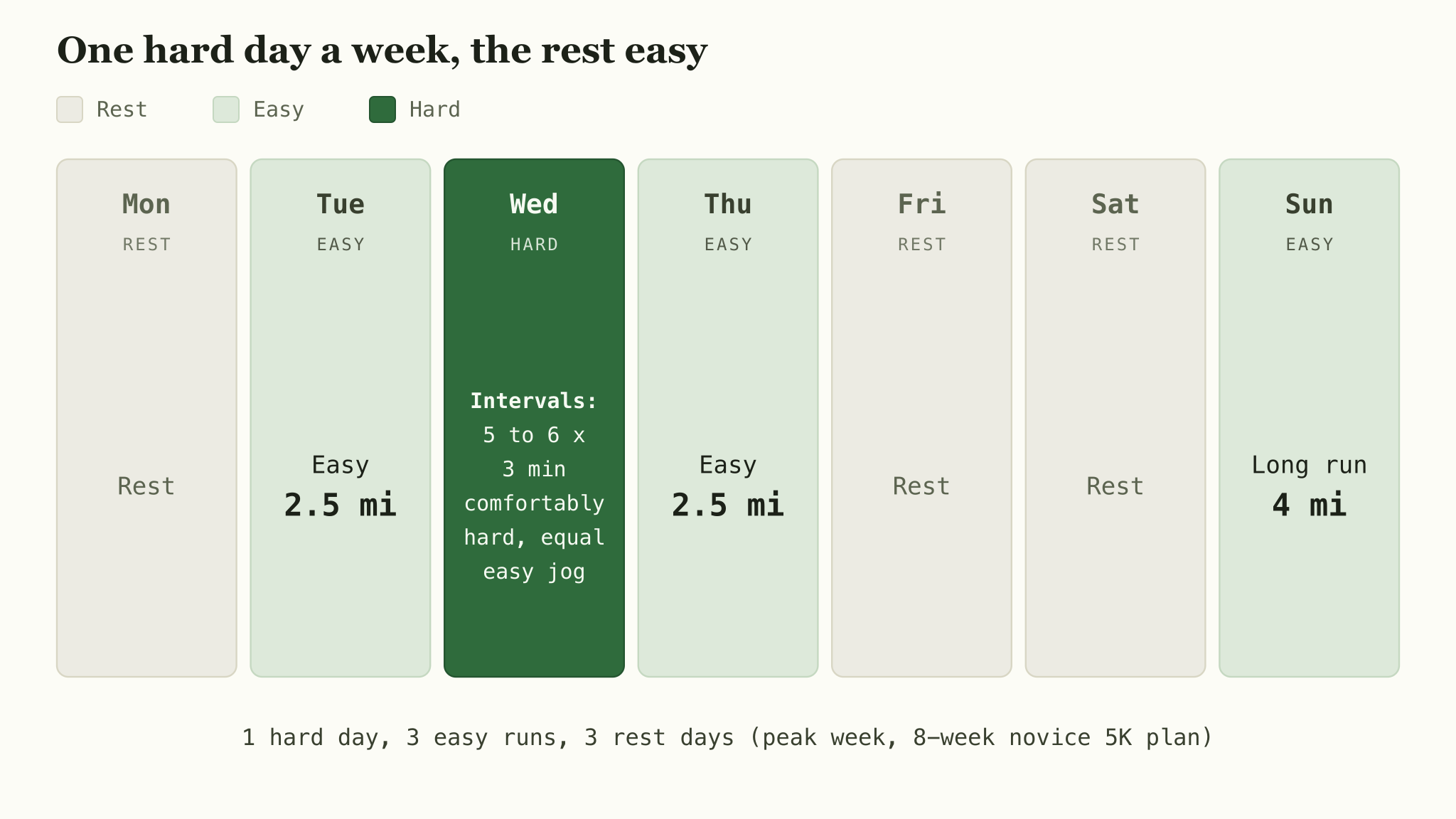
You don't need three of these a week. Those were 40 moderately trained men in a lab study, and every session they ran was a workout. On four running days, one interval session puts you close to Seiler's split: one hard day, three easy ones. Our generator puts it on Wednesday as 5 to 6 x 3 minutes comfortably hard, with an equal easy jog between, plus a warm-up and a cool-down.
Pace the reps by effort. The last one should be as fast as the first, only harder to hold. If it's clearly slower, start the next session a little slower.
Add strides and a little strength work
Some of your 5K speed lives in your legs. Paavolainen's team at Finland's Research Institute for Olympic Sports took 10 trained endurance athletes and swapped 32 percent of their training for explosive work: sprints, jumps, and light leg exercises done fast. Nine weeks later, with total training time unchanged, their 5K times had improved and their VO2max hadn't moved. The control group's VO2max went up, and their 5K times stayed where they were.
The authors traced the gain to running economy and muscle power: the same speed cost less oxygen. A 2016 meta-analysis by Carlos Balsalobre-Fernández pooled five controlled trials of 93 competitive distance runners and found a large improvement in running economy from strength training. The programs that worked used low to moderate loads, two or three times a week, for 8 to 12 weeks.
You don't need a gym for the cheap version. Strides are 20-second pickups to about mile-race speed, run relaxed, with a full walk back between them. Do four to six after two of your easy runs each week. Then add two short sessions of squats, lunges, calf raises and low hops, about 20 minutes each, on easy days. Leave the interval day alone.
How many miles a week do you need for a faster 5K?
Fewer than most people guess: 12 to 20 miles a week over four days covers a novice or intermediate 5K block. Our generator's 8-week novice 5K plan peaks at 14 miles (23 km) a week, and the intermediate plan peaks at 20.5 miles (33 km). The long run tops out at 4 and 4.5 miles, a little past race distance.
Easy mileage builds the aerobic base the intervals sit on, but how fast you add it decides whether you stay healthy enough to use it. Keep each week's rise under 10 percent and make every fourth week lighter. Our 5K to 10K training plan guide goes through the injury data behind that cap. If you add a fifth running day, make it another easy run, not a second hard one.
An eight week plan for a faster 5K
Here's what our generator lays out for a novice runner, four days a week, eight weeks out from a 5K, in miles:
- Week 1, 9.5 miles, 2.5 mile long run
- Week 2, 10.5 miles, 3 mile long run
- Week 3, 11.5 miles, 3.5 mile long run
- Week 4, 7.5 miles, 2 mile long run (step back)
- Week 5, 12.5 miles, 3.5 mile long run
- Week 6, 14 miles, 4 mile long run (peak)
- Week 7, 9 miles, 2.5 mile long run (taper)
- Week 8, an easy 1.5 miles on Wednesday, a 1 mile shakeout with strides on Friday, and the 5K on Sunday
Wednesday is the interval day for the first six weeks. In weeks 7 and 8 every run is easy, and race week keeps a little speed in the legs through the strides. In kilometers the weekly totals read 15, 17, 19, 12, 20, 23, 15 and 10.
Week 4 drops by about a third on purpose. The fitness from weeks 1 to 3 shows up once the load comes off, so the lighter week is part of the training. Skip it and you start week 5 still tired from week 3.
How should you pace a 5K race?
Hold an even pace, or start a few percent quick if you know your current fitness well. Gosztyla and colleagues had 11 trained women run 5K time trials on a treadmill, with the first mile at goal pace, 3 percent faster, or 6 percent faster. The 6 percent start finished fastest on average: 20:39, against 21:11 at even pace.
Read that with care. Eight of the eleven ran their best time off the 6 percent start, but the average times weren't statistically different, it was a treadmill with no hills or crowds, and nobody tested a start faster than 6 percent. For a 30:00 goal (9:39 a mile), 3 to 6 percent quick is a first mile between 9:07 and 9:22. An 8:45 first mile because the crowd went out hard is outside anything that study supports.
A first race is a different case. Start a little slower than goal pace, as our guide on 5K distance and pacing explains, and save the quick start for when you know what your legs can hold.
Doing less in the last week can be worth half a minute. In Houmard's 1994 study, eight trained runners cut their running by 85 percent for seven days, kept a little fast work, and ran a 5K time trial 29 seconds faster than before. Eight runners who kept training as normal ran the same time they started with.
Source: Houmard J.A., Scott B.K., Justice C.L., Chenier T.C., The effects of taper on performance in distance runners, Medicine and Science in Sports and Exercise, 26(5):624-631, 1994.How long should you taper for a 5K?
About a week. Houmard's group at East Carolina University cut trained runners' volume by 85 percent for seven days while keeping short, fast intervals. Their 5K time trial dropped by 3 percent, from 17:16 to 16:47, and their running economy improved by 6 percent. Runners who tapered on a bike held their time, and the group that kept training normally didn't improve.
On an 8-week 5K plan our generator gives you two lighter weeks: week 7 runs about 36 percent below the peak and race week about 54 percent below. If you'd rather copy Houmard's runners, keep one short session early in race week, five 400 meter repeats at 5K pace for example, and keep the total low. Our guide to how a taper works covers what to cut and what to keep.
Put the plan on paper
You don't have to build this by hand. Our free running plan generator takes your race date, your current level and how many days a week you can run, then prints the whole block as a PDF with the Wednesday intervals, the step-back week and the taper already placed. Pick 5K as the distance. No signup, no email, no app.
Then race something before week 1. A parkrun or a local 5K gives you the baseline the whole plan is measured against, and the same course eight weeks later tells you whether it worked.
Sources
- Muñoz I., Seiler S., Bautista J., España J., Larumbe E., Esteve-Lanao J., Does polarized training improve performance in recreational runners?, International Journal of Sports Physiology and Performance, 9(2):265-272, 2014; 30 recreational runners, 10 weeks, 10K improved 5.0 percent (39:18 to 37:19) with about 77/3/20 percent easy/moderate/hard versus 3.6 percent (39:24 to 38:00) with 46/35/19 (pubmed.ncbi.nlm.nih.gov).
- Seiler S., What is best practice for training intensity and duration distribution in endurance athletes?, International Journal of Sports Physiology and Performance, 5(3):276-291, 2010; about 80 percent of sessions at low intensity and 20 percent high intensity (pubmed.ncbi.nlm.nih.gov).
- Helgerud J. et al., Aerobic high-intensity intervals improve VO2max more than moderate training, Medicine and Science in Sports and Exercise, 39(4):665-671, 2007; 40 moderately trained men, 3 days a week for 8 weeks, VO2max up 7.2 percent with 4 x 4 minutes and 5.5 percent with 15/15 intervals (pubmed.ncbi.nlm.nih.gov).
- Paavolainen L., Häkkinen K., Hämäläinen I., Nummela A., Rusko H., Explosive-strength training improves 5-km running time by improving running economy and muscle power, Journal of Applied Physiology, 86(5):1527-1533, 1999; 9 weeks, 32 percent of training replaced by explosive work (pubmed.ncbi.nlm.nih.gov).
- Balsalobre-Fernández C., Santos-Concejero J., Grivas G.V., Effects of strength training on running economy in highly trained runners: a systematic review with meta-analysis of controlled trials, Journal of Strength and Conditioning Research, 2016; 5 studies, 93 competitive runners (pubmed.ncbi.nlm.nih.gov).
- Gosztyla A.E., Edwards D.G., Quinn T.J., Kenefick R.W., The impact of different pacing strategies on five-kilometer running time trial performance, Journal of Strength and Conditioning Research, 20(4):882-886, 2006; 11 women, first mile even, 3 or 6 percent fast, finishing in 21:11, 20:52 and 20:39 (pubmed.ncbi.nlm.nih.gov).
- Houmard J.A., Scott B.K., Justice C.L., Chenier T.C., The effects of taper on performance in distance runners, Medicine and Science in Sports and Exercise, 26(5):624-631, 1994; 7-day taper with an 85 percent volume cut, 5K time trial 3 percent faster (1036 to 1007 seconds) (pubmed.ncbi.nlm.nih.gov).
- Stevinson C., Hickson M., Changes in physical activity, weight and wellbeing outcomes among attendees of a weekly mass participation event: a prospective 12-month study, Journal of Public Health, 41(4):807-814, 2019; 354 new parkrun registrants, run times suggested a 12 percent fitness gain (pubmed.ncbi.nlm.nih.gov).
- Jones A.M., Doust J.H., A 1% treadmill grade most accurately reflects the energetic cost of outdoor running, Journal of Sports Sciences, 14(4):321-327, 1996 (pubmed.ncbi.nlm.nih.gov).
- Outside Run, on what counts as a good 5K time, analysis of 2.2 million 2024 US 5K road-race results (run.outsideonline.com).
- TrailTaper running plan generator, src/calc/running.ts: 8-week novice 5K build peaking at 14 miles a week with a 4 mile long run, Wednesday intervals of 5 to 6 x 3 minutes, a 35 percent step back in week 4, and a two-week taper (trailtaper.com).
Frequently asked questions
How long does it take to improve your 5K time?
Eight weeks is enough for a real change. Helgerud's interval groups raised VO2max by 5.5 to 7.2 percent in eight weeks, and the 3 to 5 percent race gains in the Muñoz trial took 10. Newer runners keep improving for months: parkrun newcomers' times pointed to a 12 percent fitness gain over a year.
Is it better to run more miles or do more speed work?
Both, at about four easy runs to one hard one. Seiler's review of endurance athletes found about 80 percent of sessions easy and 20 percent hard. A second or third interval day usually eats into the easy mileage the intervals depend on, so build easy volume first and keep one quality session a week.
What is a good 5K time to aim for?
Across 2.2 million US 5K results from 2024, the median finish was near 36 minutes, about 32 for men and 39 for women, and only 1.85 percent of finishers broke 20 minutes. Breaking 30 minutes takes a 9:39 mile. Pick a target 3 to 5 percent under your current best rather than a round number.
Can I improve my 5K time on a treadmill?
Yes. Intervals and easy runs work the same indoors. Jones and Doust found that at 8:03 a mile and slower, a flat belt and a 1 percent incline both matched the energy cost of road running. At about 7:09 a mile and faster, only the 1 percent incline did. Set it there for faster sessions.
How often should I race a 5K while training?
Once before the block and once at the end is enough. A weekly parkrun can stand in for that week's interval session if you run it hard, but don't run it hard on top of the intervals. Racing flat out every weekend leaves too little room for the easy miles.
Do I need to run longer than 5K in training?
A little. Our 8-week novice 5K plan builds the long run from 2.5 to 4 miles and the intermediate plan reaches 4.5. Both pass 3.1 miles at an easy pace, which builds the endurance to hold your pace through the third mile on race day.