Couch to 5K on a treadmill
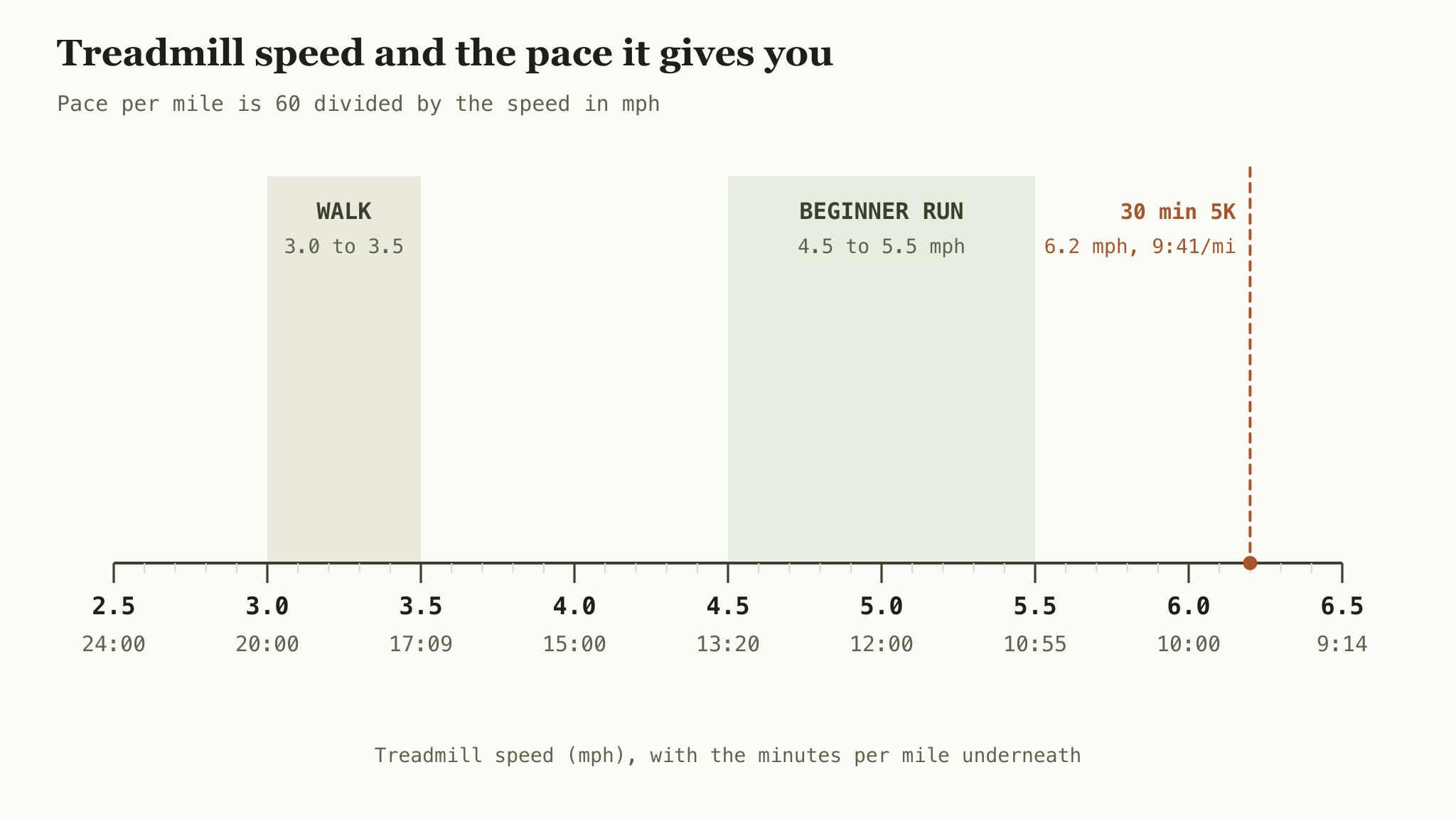
Yes, you can do the whole of couch to 5K on a treadmill. The NHS says so on its own Couch to 5K page, and the program doesn't change: nine weeks, three runs a week, rest days in between. What changes is that you have to pick the numbers yourself. For most beginners that means walking at 3.0 to 3.5 mph, running at 4.5 to 5.5 mph, and leaving the incline between 0 and 1 percent. Here's how to set each one, what the 1 percent rule is based on, and how to stay off the list of roughly 22,500 people a year who end up in a US emergency room after a treadmill accident.
Can you do couch to 5K on a treadmill?
You can, and for plenty of people it's the easier way to start. The NHS Couch to 5K guidance tells beginners who don't like running outside to do their runs on a treadmill instead. The belt is flat, the surface is soft, there's no traffic, and you can't quit halfway round a loop and walk home.
The plan itself is identical. Week 1 on the NHS version is short runs of 60 seconds with walking breaks of 90 seconds, and by week 9 you run for 30 minutes without stopping. The walking still does the heavy lifting, as our main couch to 5K guide explains: tendons and joints adapt slower than your lungs, so the breaks keep the load low while they catch up.
Two things are different indoors. The machine sets your pace, so you can't drift slower when you're tired without pressing a button. And the display tells you exactly how far you went, which is useful and sometimes discouraging.
What speed should you run for couch to 5K?
Start the run intervals at 4.5 to 5.0 mph and the walks at 3.0 to 3.5 mph. If you can't say a full sentence during a run interval, drop the speed by 0.3 mph and try again. The right speed is the one that lets you finish every interval in the session, not the one that looks respectable on the screen.
Treadmills show speed, but most running advice talks in pace, so here's the conversion. Pace per mile is 60 divided by the speed in mph.
- 3.0 mph (4.8 km/h) is a 20:00 mile, or 12:26 per km
- 3.5 mph (5.6 km/h) is 17:09 per mile, 10:39 per km
- 4.0 mph (6.4 km/h) is 15:00 per mile, 9:19 per km
- 4.5 mph (7.2 km/h) is 13:20 per mile, 8:17 per km
- 5.0 mph (8.0 km/h) is 12:00 per mile, 7:27 per km
- 5.5 mph (8.9 km/h) is 10:55 per mile, 6:47 per km
- 6.0 mph (9.7 km/h) is 10:00 per mile, 6:13 per km
The walk speed matters more than people think. The CDC counts walking at 2.5 mph or faster as brisk, moderate-intensity exercise, so a 3.0 to 3.5 mph walk is still training. Don't crawl at 2 mph to recover. You'll cool down between runs and the next one will feel harder.
Keep the run speed the same for the whole nine weeks, at least at first. The plan gets harder by making the runs longer, not faster. If week 7 at 5.0 mph feels easy, that's the plan working. Speed can come later.
Should the treadmill be on an incline?
Set it to 1 percent if you like, but at beginner speeds it barely matters. The 1 percent rule comes from one 1996 study by Andrew Jones and Jonathan Doust. Nine trained male runners ran on a treadmill at several grades and on a flat road, and a 1 percent grade matched the oxygen cost of road running at speeds from about 6.5 to 11.2 mph.
Read that speed range again. The slowest pace they tested was about 9:11 per mile, and even there, 0 and 1 percent both matched the road. The extra effort outdoors comes largely from pushing through air, and air resistance grows with speed. At 5 mph you're barely moving any air at all.
So for couch to 5K, 0 to 1 percent is fine. Don't go higher to "make it count." A steep incline loads your calves and Achilles tendon, which are two of the tissues the walk breaks are there to protect. If you want hills, save them for after week 9.
The 1 percent treadmill rule comes from nine trained runners in a 1996 study, all running at 6.5 mph or faster. At the slowest speed tested (a 9:11 mile), a flat belt and a 1 percent grade matched the road equally well. Most couch to 5K runners go slower than that, so any setting from 0 to 1 percent is fine.
Source: Jones A.M. and Doust J.H., A 1% treadmill grade most accurately reflects the energetic cost of outdoor running, Journal of Sports Sciences, 14(4):321-327, 1996.The nine weeks, set up for the belt
This is what our free generator lays out for a 9-week couch to 5K at three days a week. The run and walk times are the literal output, and each session repeats the interval the number of times shown.
- Week 1: run 1 minute, walk 2:30, eight times
- Week 2: run 2:15, walk 2:11, seven times
- Week 3: run 3:30, walk 1:53, six times
- Week 4: run 4:45, walk 1:34, five times
- Week 5: run 6 minutes, walk 1:15, four times
- Week 6: run 7:15, walk 56 seconds, four times
- Week 7: 23 minutes of continuous easy running
- Week 8: 26 minutes continuous
- Week 9: 30 minutes continuous
Our week 1 walk is a minute longer than the NHS version's 90 seconds. That's on purpose. It's the gentlest start we could build that still reaches 30 minutes by week 9, and on a treadmill it gives you time to change the speed without rushing.
Start every session with five minutes of walking at your walk speed, and end with five more. Then use the machine's quick-speed keys if it has them. On many treadmills each press of the arrow changes the speed by 0.1 mph, so going from a 3.5 walk to a 5.0 run is 15 presses, and your one-minute run in week 1 is half over before you reach it. Set the run speed as a preset or use the number keys.
Week 7 is the big jump, from intervals to 23 minutes straight. If it goes badly, repeat week 6. Nobody is checking the calendar.
How far is 30 minutes on a treadmill?
At 5.0 mph, 30 minutes is 2.5 miles, or about 4 kilometers. That's the part the treadmill makes painfully clear: the NHS plan finishes on 30 minutes of running, not 5 kilometers. To cover a full 5K in 30 minutes you'd need to hold 6.2 mph, a 9:41 mile, which is faster than most people finish their first 5K.
That's fine. Week 9 ends with you able to run for half an hour. The distance comes afterwards. Keep your usual run speed and add two or three minutes a week until the display reads 3.1 miles: at 5.0 mph that's about 37 minutes, and at 5.5 mph about 34. Our guide to how far a 5K is has the full distance breakdown if the numbers on the screen don't match what you expected.
Does treadmill running carry over to running outside?
Yes, for the most part. A 2020 systematic review in Sports Medicine by Bas Van Hooren and colleagues compared motorized treadmill running with running on the ground across crossover studies and found the mechanics largely comparable. Stride, joint angles, forces and muscle activity were close. The differences they did find were at footstrike and in how your knee bends.
Your legs will still notice the switch. Outside, you push yourself forward instead of keeping up with a belt, you steer, and the ground has camber, curbs and wind. The first outdoor run after weeks indoors often feels harder at the same effort, and many people run it too fast because nothing is setting the pace.
The fix is to practice before race day. If you're aiming at a real 5K or a parkrun, move one of your three weekly runs outside during weeks 7 to 9. Run it by effort, not by pace. If you can talk, you're at the right speed, whatever the watch says.
Treadmill safety for new runners
Treadmills hurt a lot of people. A review of US emergency room data by Mathias Forrester estimated 451,250 treadmill injuries from 2000 to 2022. About a third were to the legs, the knee led the list at 30.8 percent of those, and strains and sprains were the most common type. Most happened at home.
A few habits cover most of it:
- Clip the safety key to your clothing every time. If you slip, the belt stops.
- Straddle the belt on the side rails when you start the machine, then step on once it's moving at walking speed.
- Don't step off a moving belt to grab a towel or your phone. Press stop first.
- Look forward, not down at your feet or at a screen on the floor.
- Let go of the handrails once you're up to speed. Holding them changes your stride and makes the session easier than the numbers say.
- Keep children and pets away from the machine, and pull the key out when you're done.
Put the plan on paper
A treadmill is the one place a paper plan works better than an app. You can't read small text on a phone while the belt is moving, and a sheet taped to the console shows the whole session at a glance. Our free running plan generator has a couch to 5K mode that builds the nine weeks above, or anything from 7 to 12 weeks to fit your date, as a printable PDF. No signup, no email.
Once you're running 30 minutes without stopping, the next step is the same whether you train indoors or out. Our 5K to 10K training plan picks up where this one ends.
Sources
- NHS, Get running with Couch to 5K: nine weeks, three runs a week with rest days, week 1 starts with 1 minute runs and 90 second walks, and runs can be done on a treadmill instead of outside (nhs.uk).
- Jones A.M., Doust J.H., A 1% treadmill grade most accurately reflects the energetic cost of outdoor running, Journal of Sports Sciences, 14(4):321-327, 1996; nine trained male runners, speeds 2.92 to 5.0 m/s (tandfonline.com).
- Van Hooren B., Fuller J.T., Buckley J.D., et al., Is Motorized Treadmill Running Biomechanically Comparable to Overground Running? A Systematic Review and Meta-Analysis of Cross-Over Studies, Sports Medicine, 2020 (pmc.ncbi.nlm.nih.gov).
- Forrester M.B., Treadmill-related Lower Extremity Injuries Treated at United States Emergency Departments, Lower Extremity Review, 2024; NEISS data 2000 to 2022, 451,250 treadmill injuries, 34.0 percent lower extremity (lermagazine.com).
- US Consumer Product Safety Commission NEISS estimate, about 22,500 treadmill-related emergency room visits in 2019, as reported in coverage of CPSC data.
- Centers for Disease Control and Prevention, How to Measure Physical Activity Intensity: brisk walking at 2.5 mph or faster is moderate intensity (cdc.gov).
- TrailTaper running plan generator, src/calc/running.ts: couch to 5K mode, 9 weeks at 3 days a week, run intervals from 1 minute to 7:15, then 23, 26 and 30 minutes continuous (trailtaper.com).
Frequently asked questions
Can I do couch to 5K on a treadmill?
Yes. The NHS tells beginners they can do their Couch to 5K runs on a treadmill if they'd rather not run outside. The plan is the same nine weeks and three runs a week. You set the walk and run speeds yourself: 3.0 to 3.5 mph to walk and 4.5 to 5.0 mph to run is a good place to start.
What treadmill speed is couch to 5K?
There's no official speed. Pick a run speed where you can still talk in full sentences, which for most new runners is 4.5 to 5.5 mph (13:20 to 10:55 per mile). Walk at 3.0 to 3.5 mph. Keep the same run speed for all nine weeks and let the longer intervals do the work.
Should I put the treadmill on a 1% incline?
You can, but it isn't needed at beginner speeds. The 1 percent rule comes from a 1996 study at 6.5 mph and faster, and even at the slowest speed tested a flat belt matched the road. For couch to 5K, 0 to 1 percent is fine. Avoid steep inclines until you've finished week 9.
Is couch to 5K on a treadmill easier than outside?
A little. There's no wind, the belt is flat and softer than pavement, and the pace doesn't drift. Research on treadmill running finds the mechanics largely the same as on the ground, but the first outdoor run can feel harder. Move one run a week outside in weeks 7 to 9 if you're entering a race.
How far is 30 minutes on a treadmill?
It depends on your speed. At 5.0 mph, 30 minutes is 2.5 miles (about 4 km), and at 5.5 mph it's 2.75 miles. To run a full 5K in 30 minutes you'd need 6.2 mph. Most people finish couch to 5K able to run 30 minutes, then add a few minutes a week to reach 3.1 miles.
Can I do couch to 5K on a treadmill with the NHS app?
Yes. The app calls out when to run and when to walk by the clock, so it works the same indoors. Set the treadmill speed before each interval starts, and use preset keys if your machine has them so a one-minute run isn't spent pressing the arrow.