Couch to 10K training plan: 20 weeks for total beginners
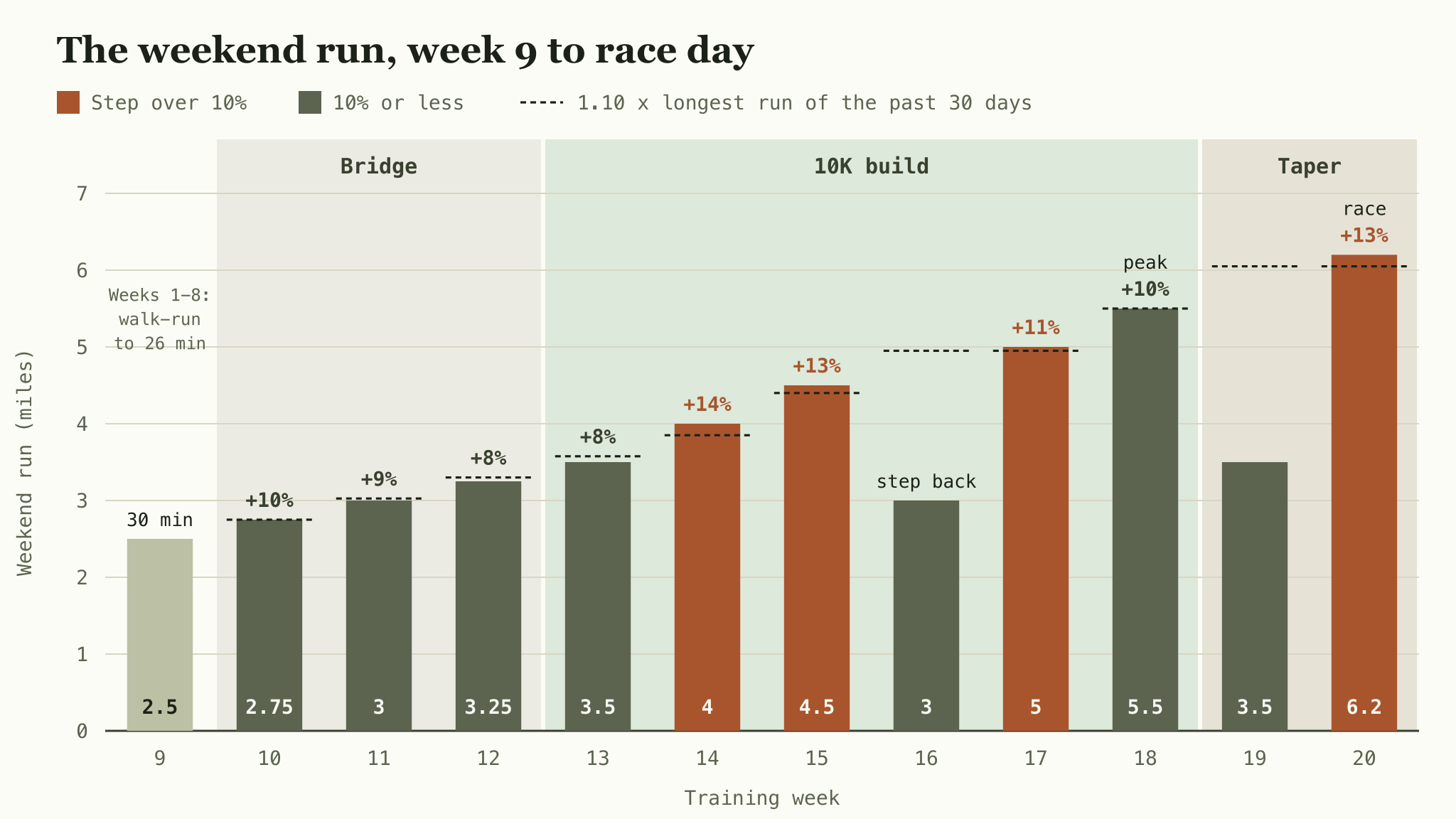
A couch to 10K training plan takes about 20 weeks if you don't run at all today. That's nine weeks of walk-run to reach 30 minutes without stopping, three bridge weeks that stretch one run a week past 5K, and an eight-week build that ends on race day. It's slower than the 12 and 14 week plans you'll find elsewhere, and the extra weeks are there for a reason. In a Dutch study of 1,696 people on a six-week start-to-run program, 10.9 percent got hurt before the program ended. Here's the whole plan week by week, and the research behind each step.
How long does couch to 10K take?
Plan on 20 weeks, or about four and a half months, from no running to a 10K race. Nine weeks get you running 30 minutes nonstop. Three more stretch your weekend run to 3.25 miles. The last eight build to a 5.5 mile long run and taper into the race. Quicker beginners can trim a week.
Published plans are shorter. Runstreet's couch to 10K, written by running coach Marnie Kunz, takes 12 weeks of run-walking with a weekly long run and two strength sessions. Zen Labs' 10K Trainer app, from the makers of the C25K app, takes 14 weeks at three sessions a week. Both are real options. Squeezing the same ground into fewer weeks means bigger steps along the way, though, and step size is where the injury research points.
Take the slower road if you fit the profile that got hurt most in that Dutch study. Kluitenberg and colleagues found injuries were more likely in older and heavier runners, in people with past muscle or joint complaints from outside sport, and in anyone with no running history. That last group includes most people starting a couch to 10K plan.
The 20 week plan at a glance
Three phases, three runs a week the whole way. Weeks 1 to 9 come straight from our generator's couch to 5K mode. Weeks 13 to 20 are its beginner 10K plan, set eight weeks out from race day. The bridge in between is our addition, and the section after this one explains why it's there.
- Weeks 1 to 6: walk-run. Week 1 is eight rounds of 1 minute running and 2.5 minutes walking. By week 6 it's four rounds of 7 minutes 15 seconds running with a 56-second walk between.
- Weeks 7 to 9: continuous running, 23, 26 and then 30 minutes, three times a week.
- Weeks 10 to 12: the bridge. Two 30-minute runs, plus a weekend run of 2.75, then 3, then 3.25 miles.
- Weeks 13 to 15: the build starts. Long runs of 3.5, 4 and 4.5 miles, weekly totals of 8.5, 9.5 and 10.5 miles.
- Week 16: step back to 7 miles, with a 3 mile long run.
- Weeks 17 and 18: 11.5 and 12.5 miles, with long runs of 5 and 5.5 miles. Week 18 is the peak.
- Week 19: taper to 8.5 miles and a 3.5 mile long run.
- Week 20: an easy 1.5 miles, a 1 mile shakeout with strides, and the 10K on Sunday.
In kilometers, the bridge runs are 4.5, 5 and 5.5 km. The build's long runs read 6, 6.5, 7.5, 4.5, 8 and 9 km, and its weekly totals 14, 15, 17, 11, 19, 20, 13 and 9 km.
Weeks 1 to 9: walk-run to 30 minutes
This is a standard couch to 5K, the same nine weeks and three runs a week as the NHS program. Every session opens and closes with a 5-minute brisk walk. Run slowly enough to talk, and if a week leaves you wrecked, repeat it. Our couch to 5K guide covers this phase in detail.
One thing about week 9 matters for a 10K. Thirty minutes of running at a beginner's easy pace covers about 2.5 miles. That's short of 5K and well under half of 6.2 miles, which is why the build doesn't start the week after.
Weeks 10 to 12: the bridge
Keep the same three days. Two runs stay at 30 minutes. The weekend run grows by a quarter mile a week: 2.75, then 3, then 3.25 miles. Each step is 8 to 10 percent longer than the last, and it leaves the build's first 3.5 mile long run as one more step of about 8 percent.
By the end of week 12 you're running a little more than 5K every weekend. If your 30-minute run in week 9 already covers 2.75 miles or more, skip week 10 and finish the plan in 19 weeks.
Weeks 13 to 20: the 10K build
This is our generator's beginner 10K plan with the race eight weeks out. The long run climbs by half a mile most weeks, drops back to 3 miles in week 16, and peaks at 5.5 miles in week 18. Then two lighter weeks carry you to the start. Wednesday becomes the one harder session: five or six 3-minute efforts at a comfortably hard pace, each followed by an equal easy jog.
Go easy on that session for the first two weeks. A second paper from the same Dutch cohort found that novices who ran harder in the previous week were more likely to get hurt. The intervals are the first fast running this plan asks of you, so keep the early reps at the gentle end of comfortably hard.
How much longer can each run get?
About 10 percent longer than the longest run you've done in the past 30 days. A 2025 study in the British Journal of Sports Medicine followed 5,205 runners through 588,071 Garmin-recorded sessions over 18 months. Runs that beat the 30-day longest by 10 to 30 percent came with a 64 percent higher injury rate.
Bigger spikes were worse. A run more than twice as long as anything in the previous month carried 2.28 times the rate. The weekly total on its own told a different story: a big week compared with the week before showed no link with injury. On these data, the number to watch is your longest run.
Weekly totals still count for beginners, though. Nielsen and colleagues followed 874 novice runners for a year and found that those who added more than 30 percent over two weeks picked up more distance-related injuries, such as runner's knee and shin splints, than those who stayed under 10. The bridge keeps both numbers small: the weekly total rises by about a quarter mile a week, and so does the weekend run.
Read the 2025 study with the right caveat. Its runners were established, with an average age of 46 and 78 percent of them men, and a cohort study shows a link rather than a cause. For a new runner it's still a sensible ceiling, and it's the reason this plan has a bridge.
The build doesn't sit under that line every week. Its half-mile steps run 10 to 14 percent: 3.5 to 4 miles is 14 percent, 4 to 4.5 is 12.5, and 4.5 to 5 is 11. If a new distance leaves your shins or knees sore two days later, run the same distance again the next Sunday instead of moving up. Race day is a 13 percent step past your 5.5 mile peak. That one you take on purpose, after two easy weeks.
The run to watch is your longest one. Among 5,205 runners tracked through 588,071 Garmin sessions, a single run 10 to 30 percent longer than anything in the previous 30 days came with a 64 percent higher injury rate. A big week next to the week before it showed no link at all.
Source: Frandsen J.S.B., Hulme A., Parner E.T. et al., How much running is too much? Identifying high-risk running sessions in a 5200-person cohort study, British Journal of Sports Medicine, 59(17):1203-1210, 2025.Can you walk during a 10K?
Yes, and planned walk breaks cost less time than most people expect. In a German trial, 42 recreational runners ran a marathon either run-walk or running only. The run-walk group finished in 4:14:25 and the running group in 4:07:40, a gap the researchers couldn't separate from chance. The run-walkers also reported less muscle pain and fatigue.
That was a marathon, four times as far as a 10K, so treat it as a hint for shorter races rather than a rule. If your long runs still have walk breaks in them by week 18, plan the same breaks for race day. One minute at each mile marker is easy to remember.
Check the race's time limit before you enter. At a brisk 15-minute walking mile, 6.2 miles takes 93 minutes. At a 12-minute running mile you'd finish in about 1:15.
How long will your first 10K take?
Expect a little over an hour, and possibly more. RunRepeat's analysis of 35 million race results from more than 28,000 events puts the average 10K at 1:02:08, with men averaging 57:15 and women 1:06:54. Only 40 percent of finishers in that data break 60 minutes, so an hour is a good time, not a baseline.
For your own estimate, use your long runs. If they settle at a 12-minute mile, a steady 10K at that effort takes about 1:15. If you race a parkrun or a local 5K during the build, our 5K to 10K guide turns that time into a 10K prediction.
The taper and race week
The last two weeks are lighter on purpose. Week 19 cuts about 32 percent off the peak week and week 20 about 56 percent, and every run in them is easy. Averaged over the two weeks that's a 44 percent cut, inside the 41 to 60 percent range that Bosquet's 2007 meta-analysis of taper studies found worked best.
This is the part that's hardest to trust. You've spent 18 weeks adding, and now the plan asks for less. Do it anyway, and keep race week boring: the same shoes, the same breakfast, nothing new on the day. Our guide on how a taper works explains why running less in those weeks makes you faster.
Put the plan on paper
Our free running plan generator builds both halves of this plan. Today, pick Couch to 5k, set the goal date nine weeks out, and print it. When week 12 ends, come back, pick 10k at the beginner level with your race date eight weeks away, and print that too. Write the three bridge runs into the gap by hand. No signup, no email, no app.
Then pick the race before week 1 and pay the entry. Twenty weeks is a long time to stay motivated without a date on the fridge.
Sources
- Kluitenberg B., van Middelkoop M., Smits D.W. et al., The NLstart2run study: Incidence and risk factors of running-related injuries in novice runners, Scandinavian Journal of Medicine and Science in Sports, 25(5):e515-523, 2015; 1,696 participants in a 6-week Start to Run program, 10.9 percent injured; higher age, higher BMI, earlier non-sport musculoskeletal complaints and no running experience raised risk (pubmed.ncbi.nlm.nih.gov).
- Kluitenberg B., van der Worp H., Huisstede B.M. et al., The NLstart2run study: Training-related factors associated with running-related injuries in novice runners, Journal of Science and Medicine in Sport, 19(8):642-646, 2016; higher running intensity in the previous week was associated with higher injury risk (pubmed.ncbi.nlm.nih.gov).
- Frandsen J.S.B., Hulme A., Parner E.T. et al., How much running is too much? Identifying high-risk running sessions in a 5200-person cohort study, British Journal of Sports Medicine, 59(17):1203-1210, 2025; 5,205 runners, 588,071 sessions, 18 months; single-session spikes of 10 to 30 percent HRR 1.64, over 100 percent HRR 2.28; no link for the week-to-week ratio (pubmed.ncbi.nlm.nih.gov).
- Nielsen R.O. et al., Excessive Progression in Weekly Running Distance and Risk of Running-Related Injuries, Journal of Orthopaedic and Sports Physical Therapy, 2014; 874 novice runners tracked by GPS for one year (jospt.org).
- Hottenrott K., Ludyga S., Schulze S., Gronwald T., Jäger F.S., Does a run/walk strategy decrease cardiac stress during a marathon in non-elite runners?, Journal of Science and Medicine in Sport, 19(1):64-68, 2016; 42 runners, run/walk 4:14:25 against running only 4:07:40 (p=0.377), less muscle pain and fatigue with run/walk (pubmed.ncbi.nlm.nih.gov).
- Bosquet L. et al., Effects of Tapering on Performance: A Meta-Analysis, Medicine and Science in Sports and Exercise, 2007; best results from a two-week taper cutting volume by 41 to 60 percent (pubmed.ncbi.nlm.nih.gov).
- RunRepeat, Compare Running Finish Times: 35 million results from more than 28,000 races; average 10K 1:02:08, men 57:15, women 1:06:54, 40 percent of finishers under 60 minutes (runrepeat.com).
- Runstreet, Couch to 10K Training Plan: 12 week program for beginners by Marnie Kunz, NASM-certified trainer and USATF and RRCA-certified running coach (runstreet.com).
- Zen Labs, 10K Trainer by C25K, App Store listing: 14 weeks total, three sessions a week, alternating walking and running (apps.apple.com).
- NHS, Get running with Couch to 5K: nine weeks, three runs a week (nhs.uk).
- TrailTaper running plan generator, src/calc/running.ts: 9-week couch to 5K mode ending on 30 continuous minutes; 8-week beginner 10K build peaking at 12.5 miles a week and a 5.5 mile long run, 35 percent step back in week 4, two-week taper (trailtaper.com).
Frequently asked questions
Can you go from couch to 10K in 12 weeks?
Some plans do it. Runstreet's couch to 10K takes 12 weeks and Zen Labs' 10K Trainer takes 14. A shorter plan needs bigger jumps in your longest run, and a 2025 study of 5,205 runners linked jumps of more than 10 percent to a 64 percent higher injury rate. Twenty weeks keeps every bridge step at 10 percent or less.
How many days a week should I run for couch to 10K?
Three. Every phase of this plan works on three runs a week, with a rest or walking day between sessions in the couch to 5K weeks. You can choose four days in the generator for the build, but the weekly totals stay the same and spread over more runs, so it adds no mileage.
Do I need to run 10K before race day?
No. The longest training run in this plan is 5.5 miles, in week 18. The last 0.7 miles come on race day, a 13 percent step taken after two lighter weeks, when your legs are fresh. Reaching the full distance in training would add weeks to the build.
What if I miss a week?
Repeat the last week you finished instead of jumping ahead. In the couch to 5K weeks that costs you one week. In the build, run the missed week in place of the week 16 step back. The missed week already rested your legs.
Is couch to 10K safe if I'm older or overweight?
Higher age and higher BMI both raised injury risk among 1,696 Dutch novice runners, so give yourself more time, not less. Repeat any couch to 5K week that leaves you sore, and keep all three bridge weeks. If you have a heart or joint condition, check with your doctor before week 1.
What is a good time for a first 10K?
Any time you finish feeling in control. For context, RunRepeat puts the average 10K at 1:02:08 across 35 million results, 57:15 for men and 1:06:54 for women. At a 12-minute mile, a steady first 10K takes about 1:15.