1.5 km to miles: 0.93 miles, 3.75 laps, and how long it takes
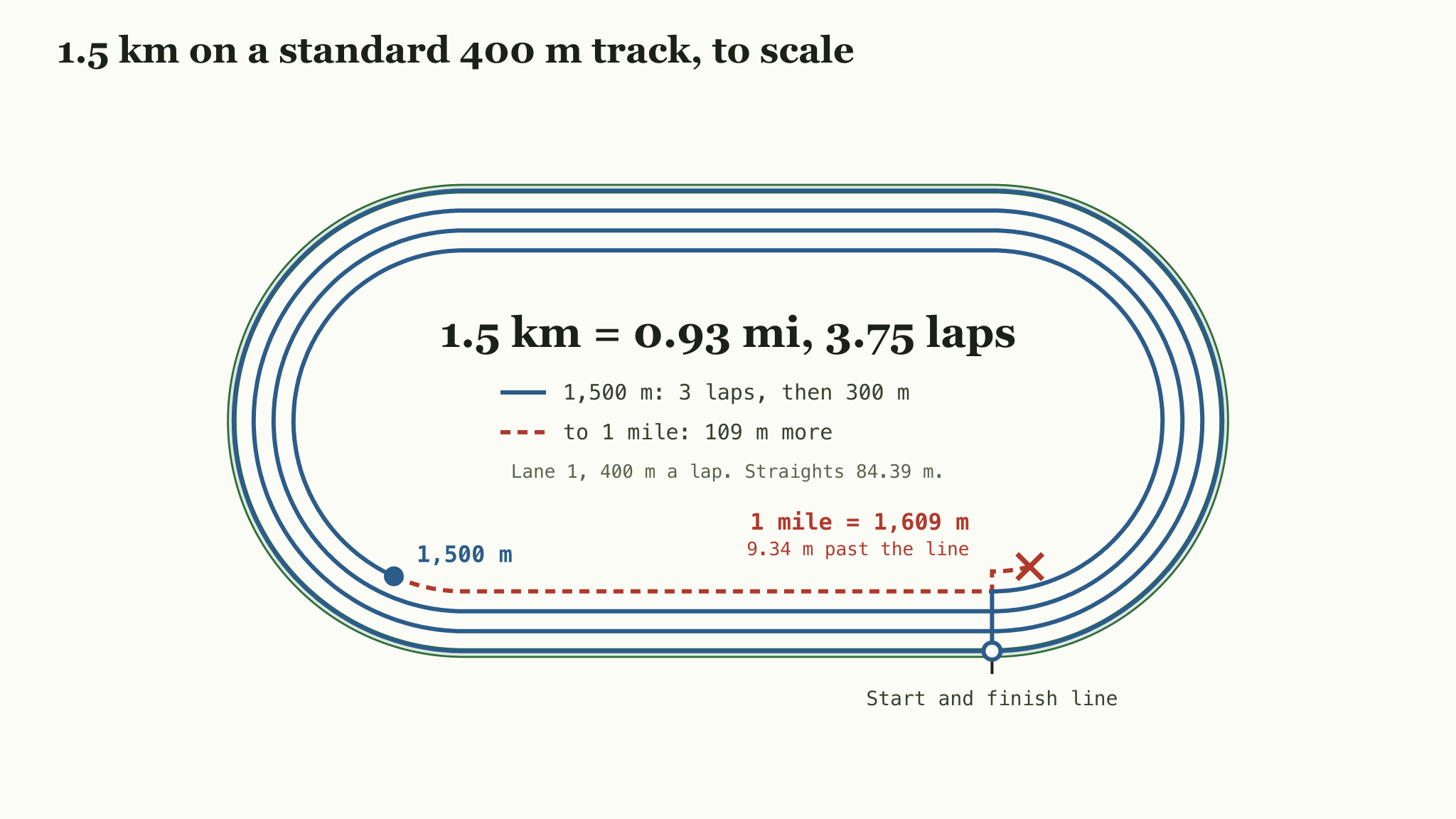
1.5 km is 0.93 miles. Spelled out, 1,500 meters is 0.932 miles, 1,640 yards, or 4,921 feet, because one mile is exactly 1.609344 kilometers under the 1959 international yard agreement. On a 400 meter track it's three and three quarter laps. Most adults walk it in about 18 minutes and most beginners jog it in 9 to 11. Here's the conversion, the laps, the times by pace, and why 1.5 km and 1.5 miles get mixed up so often.
How many miles is 1.5 km?
1.5 km is 0.93 miles, a little under one mile. The exact figure is 0.93206 miles: divide 1.5 by 1.609344. For a quick answer in your head, multiply kilometers by 0.62. That gives 0.93 here too, and it works for any distance you see on a race sign or a trail marker.
Going the other way, multiply miles by 1.6. So a full mile is 1.61 km, and 1.5 km falls 109 meters short of it. That's about 120 yards, the length of an American football field counting both end zones. On a treadmill set to miles, stop at 0.93. Stopping at 1.00 gives you a mile instead.
Is 1.5 km the same as a metric mile?
Close, and that's where the nickname comes from. Runners call the 1,500 meters the metric mile because it's the nearest Olympic event to a mile. The two are not the same distance. A mile is 1,609 meters, so it runs about 7 percent longer than the 1,500.
The world records show the gap in seconds. Hicham El Guerrouj ran 3:26.00 for 1,500 meters in 1998, and his mile record from 1999 is 3:43.13. Faith Kipyegon holds the women's 1,500 meters record at 3:48.68, set at the Eugene Diamond League in 2025, and the mile at 4:07.64 from Monaco in 2023. In both cases the extra 109 meters costs the best runners on earth about 17 to 19 seconds.
For the rest of us, Pete Riegel's endurance formula gives a fair conversion. Multiply your 1.5 km time by 1.077 to predict your mile time. A 9:00 1.5 km predicts roughly a 9:42 mile.
How many laps is 1.5 km on a track?
It's 3.75 laps of lane one on a standard 400 meter outdoor track. World Athletics measures that 400 meters along a line 30 cm out from the inside kerb. A 1,500 meter race starts 300 meters from the finish line, so runners cover that partial lap first and then three full ones.
On a 200 meter indoor track it's 7.5 laps. Outer lanes are longer, so if you run in lane four or five you'll hit 1,500 meters before the lap count says so. Count laps in lane one if you want the number to be honest.
The 1,500 meters is not a mile. It's 109 meters short, and that gap cost Hicham El Guerrouj 17 seconds between his 3:26.00 and his 3:43.13 mile. For a recreational runner, multiply your 1.5 km time by 1.077 to get a fair mile estimate.
Source: World Athletics, 1500 metres and mile world records; Riegel P.S., Athletic Records and Human Endurance, American Scientist, 69(3):285-290, 1981.How long does it take to walk 1.5 km?
About 18 minutes for most adults under 60. Bohannon and Andrews pooled walking speed data from 23,111 healthy adults and found normal pace sits near 1.3 to 1.4 meters a second from the twenties through the fifties. At that speed, 1,500 meters takes 18 to 19 minutes. In the 80 to 99 age group the average drops to about 0.95 meters a second, which stretches it to around 26 minutes.
On a hiking trail, add time for the climb. Naismith's rule, which Scottish mountaineer William Naismith worked out in 1892, gives 1 hour for every 5 km on the flat plus 1 hour for every 600 meters of ascent. A flat 1.5 km trail comes out at 18 minutes. Give it 100 meters of climbing and you need about 28.
How long does it take to run 1.5 km?
Multiply your pace per kilometer by 1.5. That's the whole calculation. A 6:00 per km jog is a 9:00 finish, and a 5:00 per km pace is 7:30. If you think in miles, multiply your mile pace by 0.93.
- 4:00 per km (6:26 per mile), 6:00
- 5:00 per km (8:03 per mile), 7:30
- 6:00 per km (9:39 per mile), 9:00
- 7:00 per km (11:16 per mile), 10:30
- 8:00 per km (12:52 per mile), 12:00
- 10:00 per km (16:06 per mile), 15:00 (a brisk walk)
Most people who have just finished a beginner plan land between 9 and 11 minutes. If you can run 1.5 km without stopping, you can also estimate your 5K. Riegel's formula puts the multiplier at about 3.6, so a 9:00 1.5 km points to a 5K near 32 minutes. Our guide to how far a 5K is breaks that distance down the same way.
How many steps is 1.5 km?
Walking 1.5 km takes roughly 2,000 to 2,250 steps. Running it takes about 1,250 to 1,650. A walking step covers about 2.2 to 2.5 feet for most adults, and a running stride stretches to 3 to 4 feet, so your count drops as you speed up. Height changes the number too, so treat a tracker's step total as an estimate.
1.5 km vs 1.5 miles: check which one your test uses
This one catches people every year. A lot of fitness tests in the US use a 1.5 mile run, and that's 2.41 km, or 914 meters longer than 1.5 km. Military.com lists the 1.5 mile run in the Navy and Coast Guard physical fitness tests, and plenty of police academies use it as an entry test. Pennsylvania's academy standard, for example, asks men aged 18 to 29 to run 1.5 miles in 13:16 and women in the same age band in 15:52.
Hold that Pennsylvania pace over 1.5 km and the men's standard works out to about 8:15. Train for the shorter distance by mistake and you'll show up fit for only 62 percent of the test. Read the paperwork twice, and if it says miles, practice the full 2.41 km.
Where else you'll see 1.5 km
Swimmers know it well. The 1,500 meter freestyle is the longest pool event at the Olympics, and the Olympic distance triathlon opens with a 1.5 km swim before a 40 km ride and a 10 km run. In a 25 meter pool that swim is 60 lengths, and in a 50 meter pool it's 30.
It also turns up as a first goal. In the NHS Couch to 5K plan, week 1 alternates 1 minute of running with 90 seconds of walking. Those eight 1-minute runs add up to about 1 to 1.3 km of running at a beginner's jog, so a first continuous 1.5 km is a fair marker of real progress.
Building up from 1.5 km
If 1.5 km is where you are now, a 5K is about nine weeks away. Our couch to 5k plan guide walks through the walk-run build week by week, with three runs a week and rest days between them. The jump from 1.5 km to 5 km sounds big, but the plan never asks for more than a small step at a time.
You don't have to plan it by hand either. The free running plan generator takes your race date and level and turns them into a week-by-week printable PDF, taper included. No signup, no email.
Sources
- NIST, The international yard and pound, 1959: one yard is exactly 0.9144 meters, so one international mile is exactly 1,609.344 meters (nist.gov).
- World Athletics, 1500 metres discipline page and records: men's 3:26.00, Hicham El Guerrouj, Rome 1998; women's 3:48.68, Faith Kipyegon, Eugene 2025 (worldathletics.org).
- Guinness World Records, fastest run one mile (female): 4:07.64, Faith Kipyegon, Monaco, 21 July 2023 (guinnessworldrecords.com).
- World Athletics, Track and Field Facilities Manual: standard 400 meter track measured 30 cm from the inner kerb in lane one, lanes 1.22 meters wide (worldathletics.org).
- Riegel P.S., Athletic Records and Human Endurance, American Scientist, 69(3):285-290, 1981; fatigue exponent 1.06 (pubmed.ncbi.nlm.nih.gov).
- Bohannon R.W. and Williams Andrews A., Normal walking speed: a descriptive meta-analysis, Physiotherapy, 97(3):182-189, 2011; 41 studies, 23,111 adults, decade-by-decade means (University of Toronto iWalk normative values summary).
- Naismith's rule, William W. Naismith, Scottish Mountaineering Club Journal, 1892: 1 hour per 3 miles (5 km) plus 1 hour per 2,000 feet (600 m) of ascent.
- Military.com, The PFT bible: 1.5 mile run in the Navy and Coast Guard physical fitness tests (military.com).
- Pennsylvania MPOETC, Basic police officer training physical fitness standards: 1.5 mile run, 13:16 for men and 15:52 for women aged 18 to 29, 30th percentile (pa.gov).
- Britannica and Olympics.com, Triathlon: Olympic distance is a 1.5 km swim, 40 km bike and 10 km run (britannica.com, olympics.com).
- NHS, Get running with Couch to 5K: nine weeks, three runs a week, week 1 alternates 1 minute running with 90 seconds walking (nhs.uk).
Frequently asked questions
Is 1.5 km a mile?
No. 1.5 km is 0.93 miles, so it's 109 meters short of a full mile. That's about 120 yards. A mile is 1.609 km, and the 1,500 meter race is called the metric mile only because it's the closest Olympic distance to one.
How long is 1.5 km in minutes?
It depends on your speed. Most adults walk 1.5 km in about 18 minutes at a normal pace. A beginner jogging at 6 to 7 minutes per kilometer finishes in 9 to 10.5 minutes. A fit club runner at 4 minutes per kilometer covers it in 6.
How many laps around a track is 1.5 km?
Three and three quarter laps of lane one on a standard 400 meter track, or 7.5 laps on a 200 meter indoor track. If you run in an outer lane, each lap is longer, so you'll reach 1,500 meters in fewer laps than the count suggests.
Is 1.5 km a good distance for a beginner?
Yes. It's long enough to feel like a real run and short enough to finish without much training. Walk it first if you need to. Once you can jog it without stopping, a 5K plan of about nine weeks is a sensible next step.
What is a good 1.5 km run time?
For a beginner, anything under 10 minutes is a solid start, which is a pace of about 6:40 per kilometer. Under 7:30 means you're holding 5:00 per kilometer, a strong recreational pace. The world record for the 1,500 meters is 3:26.00, set by Hicham El Guerrouj in 1998.
How far is 1.5 km in feet and yards?
1.5 km is 4,921 feet or 1,640 yards. One foot is exactly 0.3048 meters, so divide 1,500 by 0.3048 to get the feet figure. For a mental check, it's a little over 16 football fields laid end to end, counting 100 yards each.